
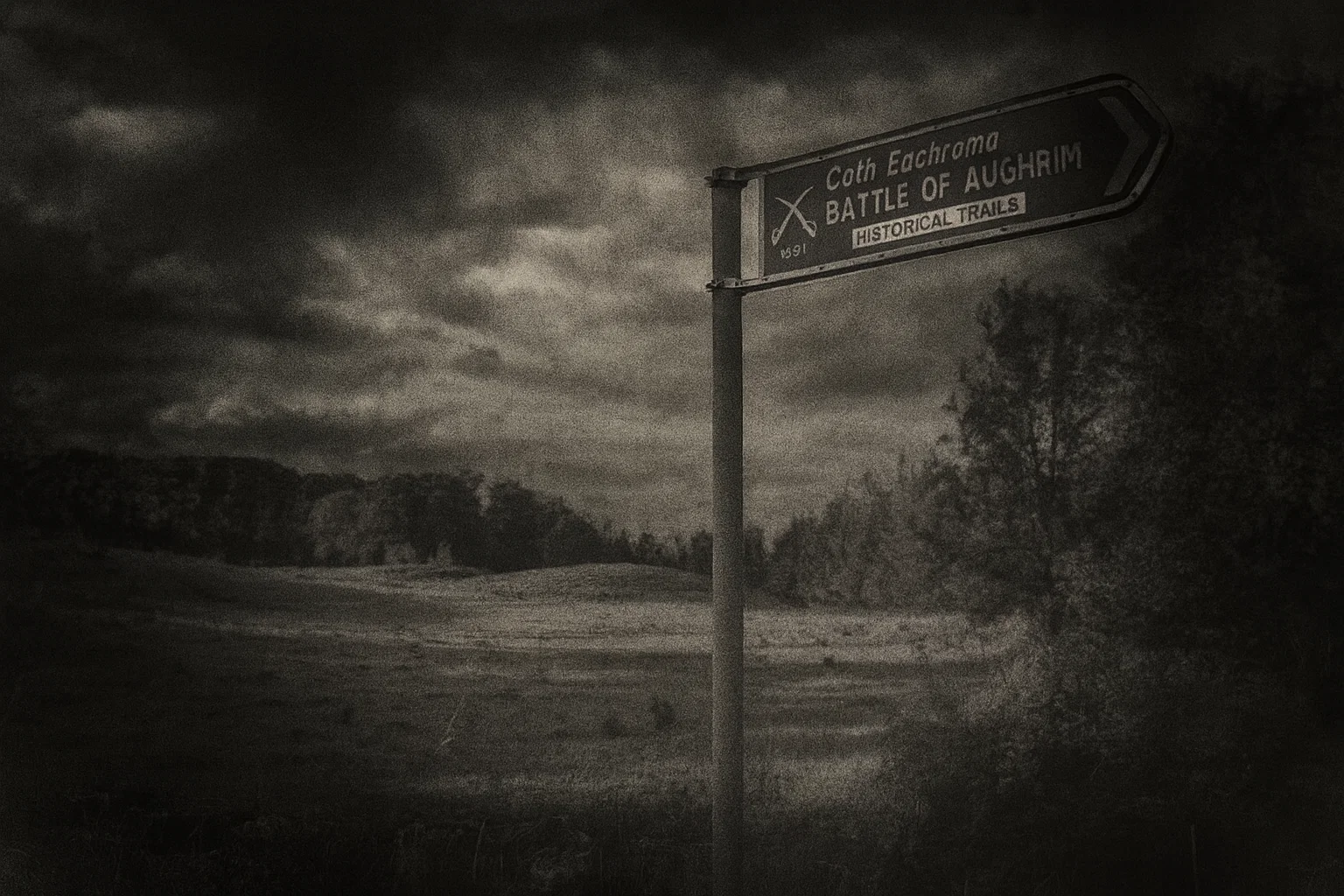

The Aughrim Battlefield haunting is associated with the site of the Battle of Aughrim in County Galway, Ireland. This battle took place in 1691 and was the decisive conflict of the Williamite War in Ireland.
The haunting here is characterized primarily by residual phenomena connected to the massive loss of life during the battle. Reports describe frequent sounds, visual apparitions, and a pervasive sense of tragedy at the site where thousands of soldiers died. Today, the area is a protected historic site that commemorates the 17th-century engagement.
Summary
Overview
| Attribute | Details |
| Name | Aughrim Battlefield |
| Other Names | Battle of Aughrim Site, Knockroe Hill |
| Address | Aughrim, County Galway, Ireland (near the village of Aughrim) |
| Country | Ireland |
| Coordinates | 53.2981° N, 8.2433° W |
| Nearest City | Ballinasloe |
| Property Type | Battlefield, Historic site |
| Built / Established | July 12, 1691 (Battle took place) |
| Closed / Abandoned | Still in use (as a historical site) |
| Owner | Irish State/Local Authority |
| Type of Haunting | Residual, Apparitions |
| Manifestations | Screams, clash of steel, phantom gunshots, shadowy figures, full-body apparitions of soldiers, spectral horses, cries of agony, eerie quietness |
| Tragic Events & Causes | Battle of Aughrim (1691) – decisive, brutal battle of the Williamite War; High casualty count (thousands of soldiers killed); Mass graves |
| Known Entities | Jacobite and Williamite soldiers, unnamed officers, spectral horses |
| Fear Rating | 7/10 (Highly Intimidating) [See Explanation] |
| First Recorded Sighting | 18th century (local folklore and early accounts of spectral battles) |
| Most Recent Sighting | Early 21st Century – reports of faint battle sounds and mist figures of soldiers by visitors and local residents |
| Activity Level | 8/10 (High Activity) [See Explanation] |
| Current Status | Open to the public as a historical site and walking trail. |
| Open to the Public? | Yes, visitors can access the field and the Aughrim Interpretive Centre nearby. |
| Best Time to Visit | Late Summer (anniversary of the battle), Late evening/Night |
| Danger Warning | Uneven terrain, isolation, sudden weather changes |
| Similar Haunted Locations | Gettysburg Battlefield, Culloden Moor, Clonmel Gaol, Loftus Hall, St. Patrick’s Cathedral, Kilmainham Gaol, Leap Castle, The Hellfire Club, Charles Fort, Belvelly Castle |
Aughrim Battlefield’s Haunted History
The haunting of Aughrim Battlefield is directly linked to the Battle of Aughrim, fought on July 12, 1691, between the forces of the deposed Catholic King James II (the Jacobites) and those of the Protestant King William III (the Williamites).
This battle was the last major engagement of the Williamite War in Ireland and had profound, long-lasting consequences for the country. The Jacobite forces, led by the Marquis de St Ruth, were strategically positioned on the high ground of Kilcommadan Hill and Knockroe Hill. Still, a critical flanking maneuver by the Williamites, under the command of General Ginkel, led to the collapse of the Jacobite right wing.
The battle itself was extraordinarily bloody and chaotic, lasting for several hours in torrential rain. Estimates suggest that between 5,000 and 7,000 men died, with the Jacobites suffering the greatest loss. The sheer scale of the slaughter, particularly during the routing of the Jacobite forces, created what is described as a river of blood flowing down the hillsides.
The dead were reportedly buried quickly in mass graves near the site, often in shallow pits, leading to a lingering atmosphere of death and violence over the area. It is the trauma and the sudden, violent end of life for thousands of soldiers that are believed to have been permanently imprinted on the land, fueling the residual and apparitional hauntings reported for centuries afterward.
Complete Home Cleansing Smudging Kit – White Sage, Palo Santo, Abalone Shell & More
This all-in-one smudging kit is designed for spiritual cleansing and energy clearing in haunted or negative spaces. It includes two California white sage bundles, three Palo Santo sticks, a beautiful 5-6 inch abalone shell with wooden stand, a natural turkey feather for directing smoke, rose quartz and amethyst crystals, plus a detailed instruction guide with blessings—everything needed to perform traditional smudging rituals for protection and positive energy.

Local Legends
On July 12, 1691, the Aughrim Battlefield was the site of a major clash between Jacobite forces loyal to King James II and Williamite forces supporting William of Orange. About 7,000 men died, making it one of the deadliest battles in Irish history. This event marked a turning point in the Williamite War. It led to the rise of the Protestant Ascendancy in Ireland.
Many of the dead, especially Jacobites, were left unburied for months. Because of the scale of death and violence, people have reported paranormal activity in the area and the nearby village. Locals have reported hearing screams and battle sounds, and seeing ghostly soldiers.
While there are no official records linking these stories to specific people, they remain part of local tradition. They are shared in folklore, at historical sites, and in visitor accounts.
Apparitions of Silent Soldiers
A well-known story describes ghostly soldiers, mostly Jacobites, appearing on the battlefield. People often see these figures standing still in the fields, looking into the distance or down at the ground, sometimes dressed in uniforms. They usually appear far away and disappear if anyone tries to get closer.
Some say the ghosts look dazed or sad, as if still affected by their defeat. These stories are thought to have begun soon after the battle and to have become part of local folklore by the early 1700s, as they were passed down through generations.
Echoes of Battle and Screams of the Dying
Many people say they have heard battle sounds at the site, like cannon fire, clashing weapons, and the screams of wounded or dying men. These sounds are often reported at night or in certain parts of the field. Local folklore says the screams of Jacobite soldiers can still be heard, reminding people of the violence that happened there.
Emily O’Donnell, a recent visitor, spent a night at the battlefield during a historical tour. She said she heard faint but clear cries and the clash of swords around midnight, which gave her chills. ‘It was as if the past was unfolding right there under the moonlit sky,’ Emily said, calling it the most vivid and surreal experience she had ever had.
The Bloody Hollow
One part of the battlefield, called the Bloody Hollow, got its name from the pools of blood that formed there during the worst fighting. This spot is known for strange activity.
According to Spirited Isle, some visitors to Aughrim Battlefield have felt intense fear and the sensation of being touched by unseen hands, especially in the Bloody Hollow. There are also reports of people seeing the ghosts of Jacobite soldiers standing silently in the field.
The Loyal Greyhound
One well-known story is about a loyal greyhound that belonged to a Jacobite soldier who died in the battle. The dog reportedly stayed by its master’s unburied body, guarding it from scavengers for months, from July until winter, until passing soldiers shot it.
People say the ghost of the greyhound still haunts the site and is sometimes seen with soldier apparitions in the Bloody Hollow. Its bark or howl is said to cause sudden fear or paralysis in those who hear it. This tale has been told since soon after the battle and is still part of local tradition.
While some locals embrace the legend as an integral part of their heritage and use it to attract tourists, others view it with skepticism. However, the story remains popular in guided tours and local storytelling events, highlighting its long-lasting influence.
Reported Ghosts
The alleged paranormal entities at Aughrim Battlefield are almost exclusively the spirits of the soldiers who perished during the battle on July 12, 1691. These ghosts are generally unidentified individuals, often referred to as Jacobite and Williamite soldiers.
The Jacobite forces, decisively defeated, are reported to have manifested most frequently. Witnesses describe seeing full-body apparitions of soldiers in 17th-century military attire, often appearing confused, wounded, or engaged in combat.
There are also accounts of spectral horsemen and horses, suggesting the presence of cavalry casualties. Although no single individual soldier is named in common folklore as the main entity, the sheer number of the fallen is the source of the haunting.
The apparitions are often perceived to be reliving their final, brutal moments, indicating a residual haunting fueled by the immense suffering and trauma experienced by the thousands of combatants.
Documented Sightings Timeline
| Witness | Date | Details |
| Local residents/Travellers | 18th Century | Early accounts of hearing phantom battle noises like screams, cannon fire, and the clash of swords near the site, often on the anniversary of the battle. |
| Farmers/Farmhands | 19th Century (Various) | Reports of seeing shadowy figures and indistinct shapes of men moving across the fields at dawn and dusk. |
| Unidentified Passerby | 1930s | A report of seeing a procession of indistinct, uniformed figures marching on the main road adjacent to the battlefield on a foggy night. |
| Local Resident | 1970s | Claimed to have witnessed a full-body apparition of a soldier near the mass grave site, described as looking pale and distraught, before fading away. |
| Visitor | Late 1990s | Reported hearing distinct, non-natural cries of agony and sudden gunshots in the middle of a quiet day near Kilcommadan Hill. |
| Paranormal Investigator Team | Early 2000s | Recorded unexplained audio phenomena and what they interpreted as faint, distant war drums using sensitive equipment. |
| Tour Group | 2010s | Multiple members of a walking tour group near the interpretive center claimed to see a misty figure resembling a man in uniform briefly standing on the ridge line. |
| Local Resident | Early 21st Century | Reported seeing spectral horses galloping across a field on a quiet evening, followed by a sudden drop in temperature and a strong feeling of despair. |
Paranormal Activity
The paranormal activity at Aughrim Battlefield is characterized primarily by auditory phenomena and visual reenactments of the battle. Investigators consistently note that the site feels like a vast echo chamber of trauma.
The most frequent manifestation is the phantom soundscape of the 1691 battle, including screams, the clash of steel, gunfire, and the cries of the wounded. These phenomena are considered classic examples of residual haunting, in which the emotional energy of a catastrophic event is repeatedly replayed on the site.
Aside from auditory events, witnesses often report a palpable, heavy atmosphere and sudden, extreme temperature drops that have no meteorological explanation. Some investigators have observed patterns of geomagnetic anomalies and elevated EMF readings that are inconsistent with known natural or man-made sources, often correlating with areas of high reported activity, particularly the mass grave sites.
The activity suggests a deep, energetic scar on the scene from the violence that happened here.
Notable Investigations
Due to its status as a major Irish historical landmark and its association with profound loss of life, Aughrim Battlefield has attracted the attention of Irish-based paranormal research groups and, occasionally, television crews focusing on historical haunts.
While specific, named investigations with published findings are limited, groups such as Paranormal Research Association of Ireland (PRAOI) and Irish Ghost Hunters have been noted for investigating historical sites across the country. They are representative of the type of professional, evidence-based teams that have visited the area.
Media coverage has also featured the site. The Travel Channel program Haunted Ireland (a segment titled “Bloody Battle Keeps Soldiers’ Souls Tethered”) explored the location, detailing the tragic history and interviewing locals about the reported phenomena.
Investigations conducted by such teams commonly involve the use of EMF meters, digital recorders for EVP, and thermal cameras. Their findings consistently report a combination of unexplained audio phenomena—such as faint screams and the clash of steel—and fluctuations in environmental readings, particularly near the known mass grave areas.
The professional consensus often points to a strong likelihood of residual haunting due to the catastrophic violence of the 1691 battle.
Tags:
Explore More Haunted Locations:
Stanley Hotel (Estes Park, CO)
February 11, 2026
Hohenzollern Castle (Baden-Württemberg, Germany)
March 2, 2026
The Queen Mary (Long Beach, CA)
February 13, 2026
Ardennes American Cemetery (Neupré, Belgium)
December 4, 2025
LaLaurie Mansion (New Orleans, LA)
February 20, 2026
Archer Avenue and Resurrection Cemetery (Justice, IL)
February 26, 2026
