
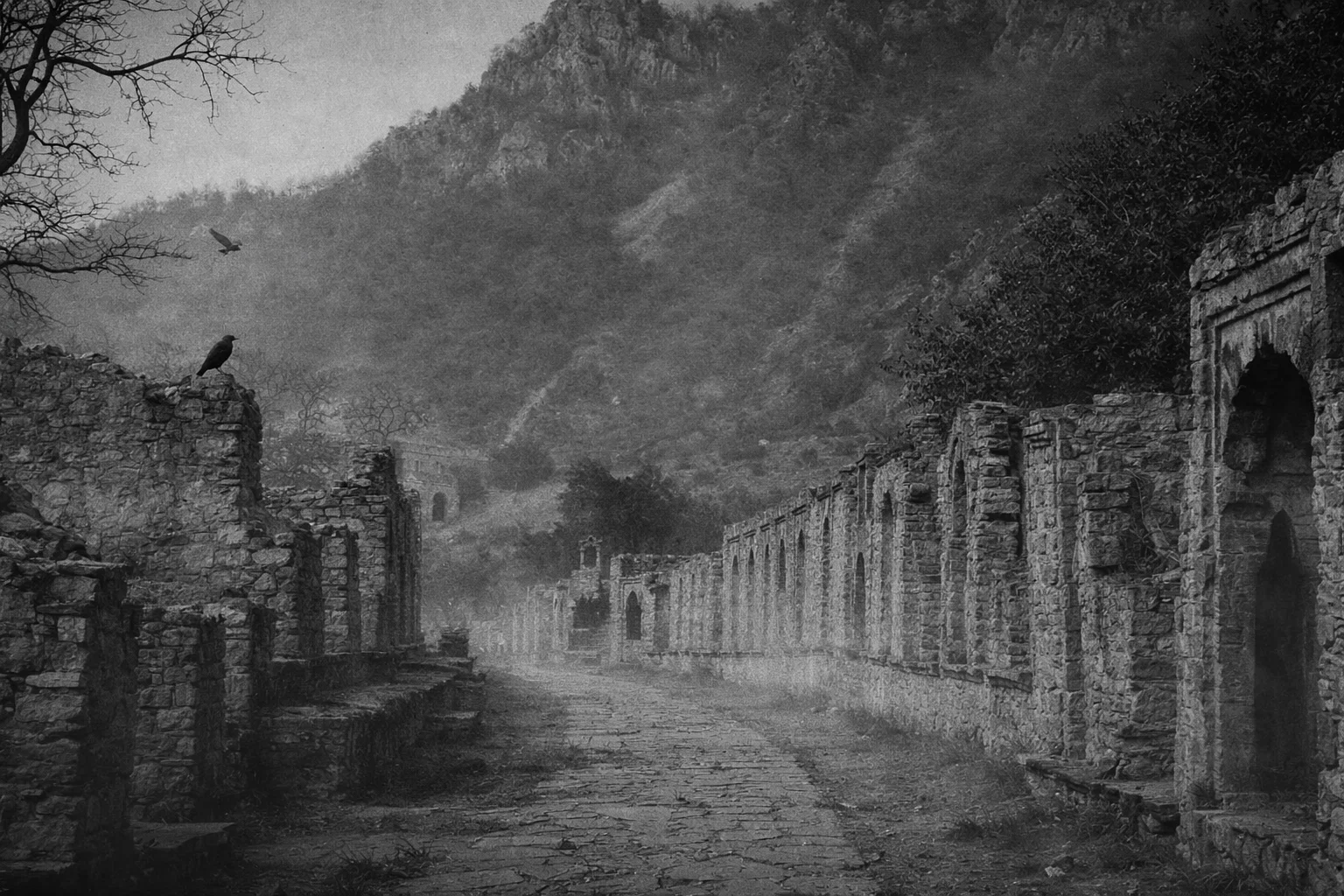

The Bhangarh Fort haunting refers to the reported paranormal events linked to a 17th-century fort in Rajasthan’s Alwar district. Often called the most haunted place in India, the fort’s ruins were suddenly abandoned in the late 1700s.
Local tradition and the Archaeological Survey of India (ASI) both ban entry after sunset and before sunrise, pointing to ongoing stories of spiritual activity and possible danger.
Summary
Overview
| Attribute | Details |
| Name | Bhangarh Fort |
| Other Names | Bhoot Bangla, House of Ghosts, Bhootiya garh, The Cursed City |
| Address | Gola ka Baas, Rajgarh Tehsil, Alwar District, Rajasthan 301410 |
| Country | India |
| Coordinates | 27.0947° N, 76.2906° E |
| Nearest City | Alwar |
| Property Type | Medieval fort and ruined township |
| Built / Established | 1573 (established by Bhagwant Das) |
| Closed/Abandoned | 1783 (fully abandoned following famine and conflict) |
| Owner | Archaeological Survey of India (ASI) |
| Type of Haunting | Residual, Apparitions, Curse |
| Manifestations | Shadowy figures, screams, music and dancing sounds, phantom scents, unexplained anxiety, feeling of being watched |
| Tragic Events & Causes | Mass deaths during Mughal invasion; devastating famine in 1783; alleged occult curses. |
| Known Entities | Princess Ratnavati, Singhia (the Sorcerer), Baba Balu Nath |
| Fear Rating | 9/10 (Extremely Terrifying) [See Explanation] |
| First Recorded Sighting | Late 1700s (Initial reports by fleeing villagers) |
| Most Recent Sighting | March 2025 – Tourists reported hearing whispers and feeling a sudden drop in temperature near the Royal Palace. |
| Activity Level | 8/10 (High Activity) [See Explanation] |
| Current Status | Archaeological site and tourist attraction |
| Open to the Public? | Yes, during daylight hours only (6:00 AM to 6:00 PM). |
| Best Time to Visit | October to March (cooler weather and peak visibility). |
| Danger Warning | Strict prohibition of night entry; presence of wild animals from the nearby Sariska Tiger Reserve; risk of falling into deep wells. |
| Similar Haunted Locations | Kuldhara Village, Dumas Beach, Agrasen ki Baoli, Shaniwar Wada Fort, Tunnel 33, Dow Hill, Fernhill Hotel, Savoy Hotel Mussoorie, Ramoji Film City, Morgan House, GP Block Meerut, D’Souza Chawl, Malcha Mahal, Lambi Dehar Mines, Jaisalmer Fort, Nahargarh Fort, Golconda Fort. |
Bhangarh Fort’s Haunted History
Bhangarh Fort’s history shows how it changed from a thriving regional center to an empty place with no clear reason. Raja Bhagwant Das built the fort in 1573 for his younger son, Madho Singh, who was a top general in Mughal Emperor Akbar’s court.
The city’s design was a strong example of medieval planning, with three layers of walls for protection. The outer wall had five large gates: Lahori Gate, Ajmeri Gate, Phulbari Gate, Ganesh Gate, and Delhi Gate. More than 9,000 people lived inside, supported by a busy Johari Bazaar and a smart water system that used nearby springs.
Bhangarh Fort stayed prosperous during Chhatar Singh’s rule, who followed Madho Singh. After Chhatar Singh died in 1630, the region’s stability broke down. As the Mughal Empire lost power, rival Rajput groups targeted Bhangarh. In 1720, Sawai Jai Singh II of Jaipur took over the city. After that, the population shrank as the fort lost its importance.
The event that cemented Bhangarh’s reputation as a place of death happened in 1783, during the Chalisa Famine. This severe drought struck Northern India, and records show the Alwar region suffered greatly. Many people starved, and the last residents quickly left.
Local stories say so many people died that they could not all be cremated, which led to the belief that the spirits of the hungry stayed with the stone buildings. When the British surveyed the area in the 1800s, they found the city taken over by jungle, with its grand houses and the seven-story Royal Palace roofless and falling apart.
The haunted reputation is also supported by the ruins’ unusual condition. Temples like the Gopinath Temple, which stands on a 10-foot platform with detailed yellow sandstone carvings, are mostly still standing. However, every home and the palace have lost their roofs.
Skeptics say the roofs were made from organic materials that rotted over time, but local stories claim the stones are cursed so no one can live under a permanent roof inside the fort. This strange detail, along with the many deaths during the 1700s famine and later conflicts, forms the basis for the fort’s haunted reputation.
True Ghost Stories: Real Haunted Cemeteries and Graveyards
This 119-page paperback by Zachery Knowles collects real paranormal accounts from some of the world’s most haunted cemeteries and graveyards. From violent poltergeists in Scotland’s Greyfriars Kirkyard to hellhounds in Stull Cemetery (rumored gateway to Hell), and shadowy figures in London’s Highgate, it explores ghostly cowboys, cursed ancient spirits, phantom animals, and more across the US, UK, Ireland, Egypt, and beyond—true stories that reveal why these burial grounds remain restless.

Local Legends
Two main legends try to explain why Bhangarh Fort is considered cursed and why the ruins have no roofs.
The Curse of Baba Balu Nath
The most historically based legend is about a local holy man named Baba Balu Nath, who lived on the hill where the fort was planned. When Raja Madho Singh wanted to build the fort, the hermit agreed but set a strict rule: the palace’s shadow could never fall on his meditation spot. He warned that if it did, the whole city would be destroyed.
For many years, the rulers kept this promise. But a later prince, Ajab Singh, ignored the warning and added tall columns to the palace. The new shadow covered the hermit’s retreat. In response, Balu Nath cursed the city to fall into ruin. Even now, locals believe that any roof built inside the fort will collapse because of this old curse.
The Sorcerer and Princess Ratnavati
Another well-known legend is about Princess Ratnavati, daughter of Chattar Singh, who was famous for her beauty. A sorcerer named Singhia, skilled in black magic, became obsessed with her. Since he could not win her in a normal way, he tried to enchant a bottle of perfume that her maid was buying at the market. He hoped the oil would hypnotize Ratnavati when she touched it.
The princess, who also knew about magic, saw through the spell and threw the bottle at a big rock. The oil made the rock roll and crush Singhia. Before he died, the sorcerer cursed the fort and everyone living there to die suddenly, with no chance of rebirth.
Soon after, a war started between Bhangarh and Ajabgarh, and many people in the city, including the princess, were killed. Local stories say the fort is waiting for Ratnavati to be reborn and break the curse.
Reported Ghosts
People say the spirits at Bhangarh Fort are leftover energies from those who once lived there. Witnesses often report seeing shadowy figures in the market and dance halls (Nartakiyon Ki Haveli). Unlike hauntings where spirits interact, the activity here is usually described as a replay of the city’s past.
One common story is about a young boy’s ghost seen sitting in a windowless room or walking near the main gate. Some people have also seen the outline of a tall man, thought by some to be the sorcerer Singhia, watching from the palace balconies.
Female spirits are mentioned as well, often linked to the sound of dancing bells (ghungroos) from the dancers’ quarters.
Advanced P-SB7 Spirit Box – Essential Tool for Real-Time EVP Sessions
Unlock clearer spirit communication with the latest P-SB7 Spirit Box, packed with investigator-friendly features:
- Adjustable sweep speeds (including ultra-fast 50ms) and forward/reverse directions
- Built-in ATDD temperature deviation detection (±5°F alerts for cold spots)
- Noise reduction for cleaner audio, plus AM/FM selection
- Backlit display, built-in flashlight, and loud speaker for dark investigations
- Compact design with 1-year warranty and batteries included
Ideal for scanning haunted sites and capturing potential responses instantly.

Documented Sightings Timeline
| Witness | Date | Details |
| Fleeing Villagers | 1783 | Reports of hearing screams and phantom battles as the city was abandoned during the famine. |
| Local Herdsmen | Early 1900s | Claims that animals entering the fort after dark would disappear or return in a state of terror. |
| Two Young Explorers | Late 1900s | Anecdotal report of two boys who stayed overnight; they reportedly vanished and were never found. |
| Youth Group | 2012 | A group of three visitors fell into a well; while being rescued, they were killed in a car accident, which locals attributed to the curse. |
| Paranormal Tourists | November 2021 | Witnesses reported the distinct scent of “ittar” near the palace ruins despite no one being nearby. |
| Photography Team | August 2024 | Several digital photos showed dark, humanoid blurs in the Gopinath Temple area where no people were standing. |
| Travel Vlogger | January 2026 | Recorded “disembodied whispers” and experienced equipment failure while filming near the royal stables. |
Paranormal Activity
Paranormal activity at Bhangarh Fort is said to be strongest during twilight. Visitors often feel a heavy, tense atmosphere that causes sudden anxiety or a need to escape. Most reports involve sounds, such as market chatter, clashing swords, and cries from empty rooms.
A common trend over the years is that electronic devices often fail. Batteries drain quickly, and the camera’s shutter sometimes jams, especially at the Royal Palace or the Tantrik’s house. Many people also report sudden cold spots or the feeling of a hand touching their shoulder.
Notable Investigations
Because entering at night is legally restricted, official investigations are rare and usually need special government approval.
- The Paranormal Company (2023): Lead investigator Jay Alani and his team did a survey of the site during the day and evening. They used EMF meters and EVP recorders and found several electromagnetic spikes near the palace. Alani often argues against the idea of a “curse” but admits the site has a unique, unsettling energy.
- Various News Agencies: Several Indian news channels have tried to stay near the fort at night with security. Most do not find visual proof of ghosts. Still, reporters often record feelings of distress and equipment failures with no clear technical cause.
Recent News and Theories
A growing theory among researchers is that infrasound from the shape of the Aravalli Hills and Sariska forest affects people at the fort. Wind blowing through the stone ruins may create low sounds that make people feel sick, cold, or even hallucinate. This could explain the “eerie quiet” and fear that tourists report.
In January 2025, a report came out about a planned archaeological restoration project. Local workers were said to be hesitant to work on the upper parts of the palace, citing the legend of Baba Balu Nath and fears that repairing the roofs could bring more “misfortune” or cause collapses like those described in local stories.
Tags:
Explore More Haunted Locations:
Château de Brissac (Maine-et-Loire, France)
February 5, 2026
Hohenzollern Castle (Baden-Württemberg, Germany)
March 2, 2026
January 13, 2026
Alcatraz Island (San Francisco, CA)
December 1, 2025
Hoia-Baciu Forest (Cluj-Napoca, Romania)
February 2, 2026
Eastern State Penitentiary (Philadelphia, PA)
February 4, 2026
