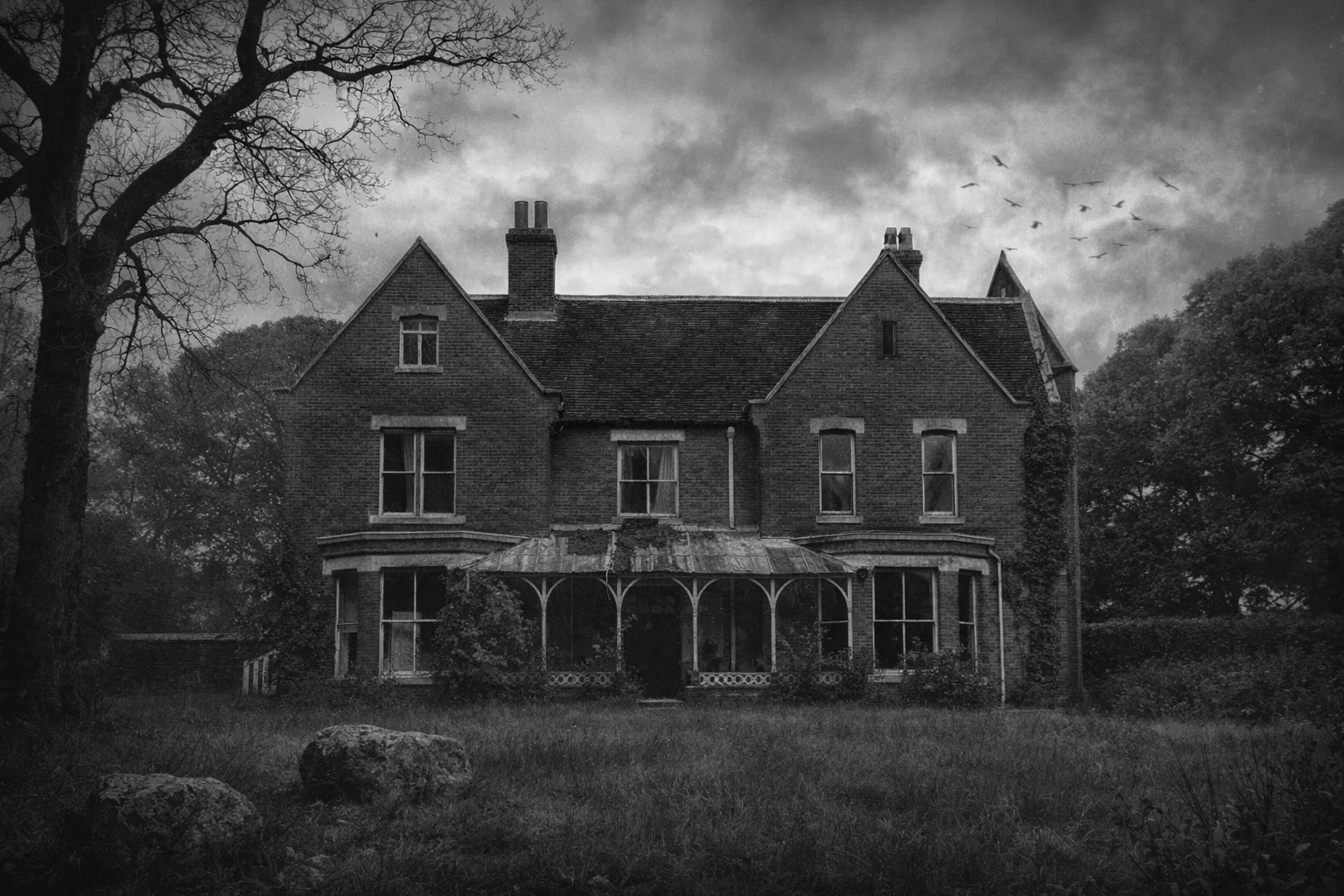

Borley Rectory, a Victorian mansion in Borley, Essex, became famous as England’s most haunted house. Reports included ghosts, poltergeist activity, and strange messages on the walls. Public interest peaked in the 1920s and 1930s when Harry Price investigated the site.
Even though the original building was destroyed by fire and later torn down, people still report paranormal activity on the grounds and in the nearby church.
In recent years, new investigations have looked into these claims. In 2021, a paranormal research team recorded unexplained voices and sudden temperature drops in the churchyard. In 2022, independent investigators saw shadowy figures and strange lights near the ruins.
Summary
Overview
| Attribute | Details |
| Name | Borley Rectory |
| Other Names | The Most Haunted House in England |
| Address | Hall Lane, Borley, Sudbury, Essex CO10 |
| Country | United Kingdom |
| Coordinates | 52.0545° N, 0.6941° E |
| Nearest City | Sudbury |
| Property Type | Victorian mansion (demolished), now vacant land and churchyard |
| Built / Established | 1862 |
| Closed/Abandoned | 1939 (destroyed by fire), 1944 (demolished) |
| Owner | Private ownership (land), Church of England (adjacent church) |
| Type of Haunting | Poltergeist, Apparitions, Residual |
| Manifestations | Moving objects, wall writings, phantom footsteps, bells ringing, stones thrown, smells of lavender, temperature drops |
| Tragic Events & Causes | Legend of a murdered monk and nun, 1939 fire, alleged burial of human remains under the floorboards |
| Known Entities | The Nun, Reverend Henry Bull, Marie Lairre |
| Fear Rating | 7/10 (Highly Intimidating) [See Explanation] |
| First Recorded Sighting | 1863 (Unexplained footsteps shortly after construction) |
| Most Recent Sighting | Reports of phantom figures and heavy footsteps near the churchyard continue into the 2020s |
| Activity Level | 6/10 (Moderate Activity) [See Explanation] |
| Current Status | Demolished; site is an open field and a public church |
| Open to the Public? | No (The Rectory site is private), Yes (Borley Church is accessible) |
| Best Time to Visit | Autumn (specifically the anniversary of the fire in February or late October) |
| Danger Warning | Private property trespassing risks, uneven ground, structural remains near the church |
| Similar Haunted Locations | Ancient Ram Inn, Enniscorthy Castle, 30 East Drive, Loftus Hall, Woodchester Mansion, Skirrid Mountain Inn, Berry Pomeroy Castle, Chillingham Castle, Boleskine House, Ham House |
Borley Rectory’s Haunted History
Borley Rectory was built in 1862 for Reverend Henry Bull on the site of an earlier rectory. The large red-brick house was meant for a big family. Soon after moving in, the Bull family heard unexplained footsteps and thumping sounds in the halls.
Henry Bull died in the “Blue Room” in 1892, and his son Harry Bull took over. The hauntings continued, and the family’s daughters saw a ghostly nun walking outside on what became known as “The Nun’s Walk.” Harry Bull also died in the same room in 1927, and the house stayed empty until the Smith family moved in.
Reverend Guy Eric Smith and his wife moved in in 1928. They experienced strong poltergeist activity, like servant bells ringing on their own and small stones being thrown by invisible forces. The Smiths contacted the Daily Mirror, which sent Harry Price to investigate. When Price arrived, the strange events increased, including glass breaking and mysterious lights appearing.
The most active period was when Reverend Lionel Foyster and his wife, Marianne, lived there from 1930 to 1935. During this time, the haunting focused on Marianne, who said she was physically attacked by unseen forces. Messages appeared on the walls, often asking for help or directed at Marianne.
In 1937, Harry Price leased the house for a year to conduct a controlled scientific investigation with a team of observers. However, in February 1939, the new owner, Captain W.H. Gregson, accidentally knocked over an oil lamp.
The resulting fire gutted the building. Gregson reported seeing ghosts in the flames as the house burned. The ruins stood until 1944, when they were finally demolished.
True Ghost Stories: Real Haunted Cemeteries and Graveyards
This 119-page paperback by Zachery Knowles collects real paranormal accounts from some of the world’s most haunted cemeteries and graveyards. From violent poltergeists in Scotland’s Greyfriars Kirkyard to hellhounds in Stull Cemetery (rumored gateway to Hell), and shadowy figures in London’s Highgate, it explores ghostly cowboys, cursed ancient spirits, phantom animals, and more across the US, UK, Ireland, Egypt, and beyond—true stories that reveal why these burial grounds remain restless.
Local Legends
The haunting at Borley Rectory is linked to a local legend that became popular in the 1800s and 1900s. This story explains the site’s most famous ghost.
The Forbidden Romance of the Monk and Nun
The most well-known legend says a monk from a nearby monastery and a nun from a local convent fell in love and tried to run away together. They were caught, and the monk was either hanged or beheaded. The nun was said to be sealed alive inside the convent walls.
This legend was used to explain the frequent sightings of a sorrowful woman in a habit wandering the grounds. In particular, historical research has failed to find evidence of a monastery or convent on that site during the medieval period, casting doubt on the factual basis of the legend.
Despite the lack of historical documentation, the story remains an integral part of local folklore. It is the primary explanation for the site’s residual haunting, beloved by storytellers and paranormal enthusiasts alike.
The Murder of Marie Lairre
Another legend came up during Harry Price’s investigations through planchette sessions. The spirit claimed to be Marie Lairre, a French nun who left her order to marry someone from the Waldegrave family, who once lived in an earlier manor on the site.
According to the legend, her husband strangled her and buried her in the cellar. In 1943, Price found some human bone fragments during a cellar excavation. Still, it was never confirmed that they belonged to the woman from the story.
Local authorities examined the bone fragments, but because forensic technology was limited at the time, the results were inconclusive. Recently, researchers have talked about using modern DNA testing to learn more about where the bones came from.
Reported Ghosts
The Borley Nun is the ghost people report seeing most often. She is usually seen gliding across the lawn or looking through windows. Unlike many ghosts, she appears almost solid, yet her face is frequently described as very sad or empty.
Another ghost often seen is the Headless Coachman, who drives a phantom carriage pulled by two horses. This ghost is linked to the “Forbidden Romance” legend and is thought to be the carriage used in the failed escape. People have reported hearing hooves and wheels on the driveway, even when nothing is there.
The ghost of Henry Bull has also been reported. Dressed in his dressing dress, he has allegedly been seen standing in the garden or hallways before the rectory was destroyed. People have also reported seeing the ghost of Henry Bull, wearing his dressing dress, standing in the garden or hallways before the rectory was demolished.
Journey to Earth’s Most Haunted Realms – National Geographic Supernatural Places
This beautifully produced hardcover book from National Geographic takes you on a global journey to over 100 legendary haunted and mysterious sites, blending breathtaking photography, eyewitness accounts, historical context, and folklore. From ancient cursed ruins to modern ghost hotspots, it’s an immersive guide to the planet’s most supernatural locations—ideal for armchair travelers and haunted site enthusiasts alike.
Documented Sightings Timeline
| Witness | Date | Details |
| Bull Family Daughters | July 28, 1900 | Four sisters saw the figure of a nun on the lawn; she vanished when they approached. |
| Edward Cooper | 1916 | The rectory groom and his wife saw a phantom coach and horses on the grounds. |
| Fred Cartwright | 1927 | A local man saw the nun four times in one week but was unaware the house was haunted. |
| Guy Eric Smith | 1928 | The Reverend found a woman’s skull in a library cupboard; later experienced bell-ringing. |
| Harry Price | June 1929 | Observed stones and coins being thrown and heard unexplained tapping sounds. |
| Marianne Foyster | 1930–1935 | Reported being thrown from her bed and saw wall writings appear in real-time. |
| S.H. Glanville | 1937 | An investigator for Harry Price recorded footsteps and moving household objects. |
| Captain W.H. Gregson | February 1939 | Saw two ghostly figures in the windows while the house was consumed by fire. |
| Herbert Mayes | 1944 | Demolition workers reported hearing screams and the sound of falling masonry when no work was occurring. |
Notable Investigations
Harry Price
Harry Price, a well-known psychic researcher and author, led the most famous investigation at Borley Rectory in the late 1920s and 1930s. The Daily Mirror contacted him in 1929 after the Smith family reported poltergeist activity.
Price visited and witnessed mysterious voices, servant bells ringing, and objects being thrown. People said his presence strengthened the activity, which drew a lot of media attention.
In 1937, Price rented Borley Rectory for a year to conduct a thorough investigation. He put together a team of 48 official observers, mostly educated laypeople and skeptics like doctors, lawyers, and military officers, who took turns staying in the house.
Each observer received a detailed logbook to record anything unusual, from strange sounds and ghost sightings to moving objects. Price encouraged a scientific approach, setting up rules for tracking temperature changes, light events, and wall messages.
During this investigation, people reported many strange events: phantom footsteps, sightings of the ‘Borley Nun’ inside and outside the house, unexplained knocks and bangs, sudden drops in temperature, and mysterious messages written on the walls, often addressed to Marianne Foyster, a former resident.
Price also held séances and used planchettes and Ouija boards to try to talk to the spirits. One spirit, who said she was a murdered nun named Marie Lairre, gave detailed stories about her life and death on the property. In 1943, after the house was burned and partly demolished, Price led an excavation of the cellar and found some bone fragments thought to be human, which added to the legend.
Price collected all the findings, reports, and diary entries and published them in his 1940 book, “The Most Haunted House in England.” This investigation is still seen as one of the first and most important examples of organized paranormal research, setting the standard for future ghost investigations around the world.
Society for Psychical Research (SPR)
In later years, the Society for Psychical Research (SPR) undertook a detailed and crYears later, the Society for Psychical Research (SPR) carried out a thorough investigation into Harry Price’s methods and the reported events at Borley Rectory.
In 1955 and 1956, a team led by Kathleen M. Goldney, Eric J. Dingwall, and Trevor H. Hall reviewed Price’s books, observer logs, letters, and witness statements. They published their findings in the Proceedings of the SPR in 1956.
They visited the site, interviewed local residents, and re-examined physical evidence, including the famous wall writings and artifacts from the rectory. Their report concluded that many of the phenomena described by Price—such as objects being thrown, wall writings, and apparitions—could have been caused by natural or human means, and in some cases may have been exaggerated or even fabricated.
The SPR’s investigation was particularly critical of Price’s experimental controls and record-keeping, highlighting inconsistencies in the logbooks and a lack of independent corroboration for the more dramatic reports. They also noted that some of Price’s “official observers” later admitted to playing pranks or embellishing their experiences.
However, the SPR acknowledged that not all phenomena could be easily explained, and some witness accounts remained puzzling.
The report by Goldney, Dingwall, and Hall was a turning point for Borley Rectory, moving the focus from sensational stories to skepticism and scientific study. Their work is still used as a reference for later investigations and for the wider field of psychical research, showing the challenges and value of careful investigation in studying the paranormal.
The Borley Church Hauntings
After the Rectory was demolished in 1944, most paranormal reports shifted to Borley Parish Church, a medieval building from the 12th century, right across the road from the old rectory site. The church is a Grade I listed building and still has much of its original architecture, like its stone tower, old font, and stained glass windows.
Both visitors and parishioners have reported strange events at Borley Church for many years. One of the most common stories is hearing phantom organ music when the church is locked and empty, a detail found in several written accounts and sometimes in the parish’s own records.
Sightings of a grey lady moving through the graPeople have also seen a grey lady moving through the graveyard or near the church porch. Some witnesses say she wears clothing from the early modern era. Both locals and independent investigators have reported these sightings, which adds some credibility to the stories.
Unexplained scents, such as lavender or incense, have been reported by several researchers and published in journals including the Journal of the Society for Psychical Research. While these phenomena remain unexplained, they are consistently reported by different individuals and teams over time.
Borley Church continues to attract attention from paraBorley Church still draws interest from paranormal researchers and historians. It is the last building connected to the Borley Rectory legend.
Tags:
Explore More Haunted Locations:
Stanley Hotel (Estes Park, CO)
February 11, 2026
Ancient Ram Inn (Gloucestershire, UK)
December 2, 2025
Maple Hill Cemetery (Huntsville, AL)
January 20, 2026
February 10, 2026
Archer Avenue and Resurrection Cemetery (Justice, IL)
February 26, 2026
Marion Military Institute (Marion, AL)
January 19, 2026
