
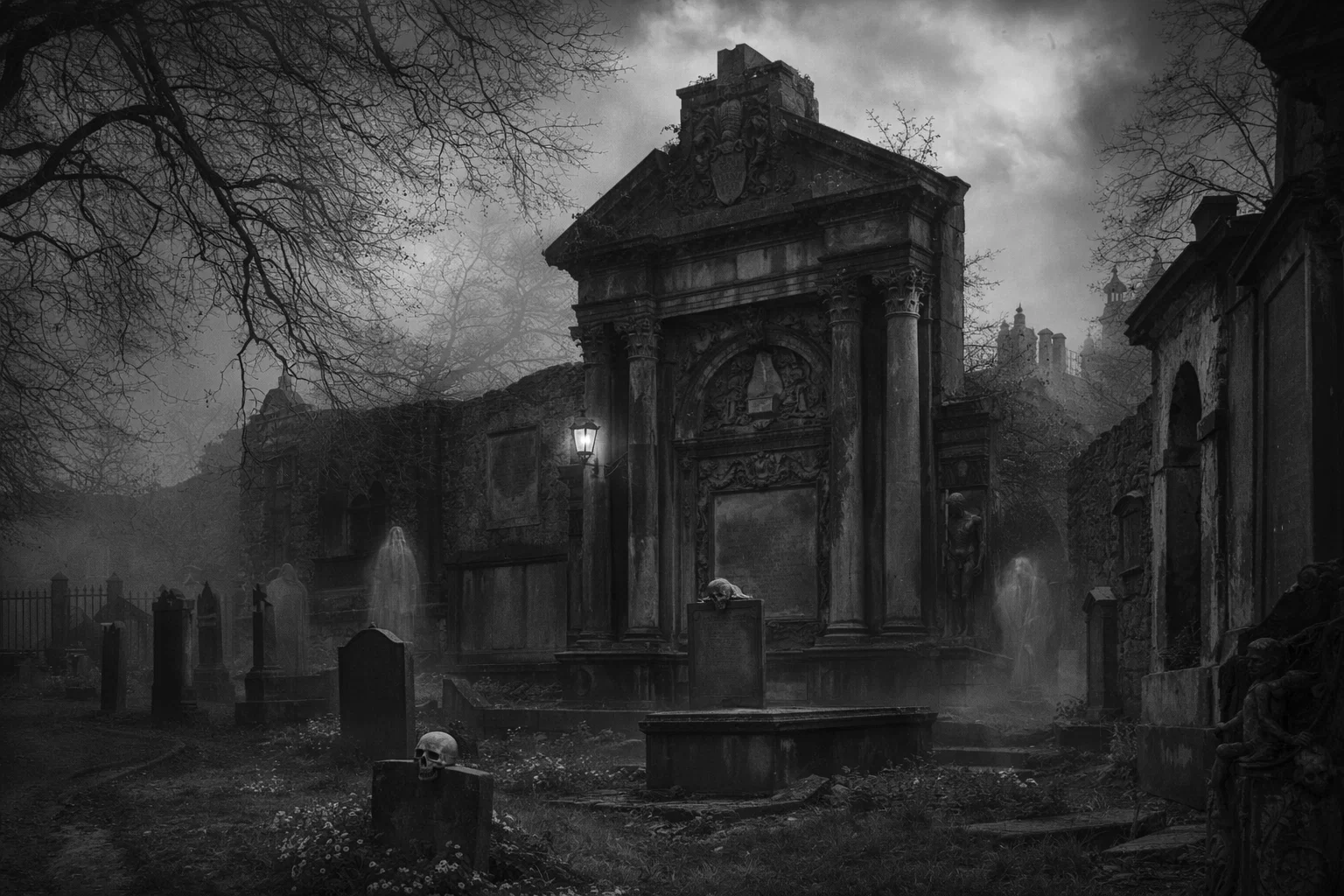

Greyfriars Kirkyard in Edinburgh is known for a series of reported paranormal events. The most famous of these is the Mackenzie Poltergeist, a hostile spirit said to haunt the Black Mausoleum.
Many visitors have reported physical injuries like scratches and burns, especially after the tomb of Sir George Mackenzie was disturbed in the late 1990s.
The site is also linked to the tragic history of the Covenanters’ Prison, where hundreds of religious prisoners suffered and died while Mackenzie was in charge.
Summary
Overview
| Attribute | Details |
| Name | Greyfriars Kirkyard |
| Other Names | The World’s Most Haunted Graveyard, Greyfriars Cemetery |
| Address | 26A Candlemaker Row, Edinburgh EH1 2QE |
| Country | United Kingdom |
| Coordinates | 55.9469° N, 3.1923° W |
| Nearest City | Edinburgh |
| Property Type | Historic Cemetery and Churchyard |
| Built / Established | 1562 |
| Closed/Abandoned | Still in use (as a public park and historic site); burials ceased in the late 19th century. |
| Owner | City of Edinburgh Council |
| Type of Haunting | Poltergeist, Residual, Apparitions |
| Manifestations | Scratches, bruises, burns, bite marks, fainting, cold spots, screams, shadowy figures, moving objects. |
| Tragic Events & Causes | Mass imprisonment and starvation of 1,200 Covenanters (1679), plague pit burials, grave robbing. |
| Known Entities | George “Bloody” Mackenzie, Greyfriars Bobby (loyal dog), Covenanter spirits. |
| Fear Rating | 9/10 (Extremely Terrifying) [See Explanation] |
| First Recorded Sighting | 1800s (reports of Mackenzie’s restless spirit by local children) |
| Most Recent Sighting | February 2026 – Ongoing reports of physical marks and cold sensations by tour participants. |
| Activity Level | 10/10 (Extreme Activity) [See Explanation] |
| Current Status | Open to the public; certain sections gated and restricted to guided tours. |
| Open to the Public? | Yes, accessible daily; Covenanters’ Prison and Black Mausoleum require a guided ghost tour. |
| Best Time to Visit | Nighttime (for ghost tours) or winter months (peak atmospheric tension). |
| Danger Warning | Risk of physical injury from poltergeist activity; restricted gated areas. |
| Similar Haunted Locations | Highgate Cemetery, St. Louis Cemetery No. 1, Edinburgh Vaults, Mary King’s Close, Eastern State Penitentiary, Tower of London, Ancient Ram Inn, Leap Castle, Chillingham Castle, Bachelors Grove Cemetery, Waverly Hills Sanatorium, Poveglia Island, Skirrid Mountain Inn, Berry Pomeroy Castle, Woodchester Mansion, Pendle Hill, Dalhousie Castle, Crumlin Road Gaol. |
Greyfriars Kirkyard’s Haunted History
Greyfriars Kirkyard’s dark past is closely tied to the religious and political turmoil of 17th-century Scotland, when the Covenanters faced harsh persecution. After the Battle of Bothwell Bridge in 1679, the kirkyard changed from a peaceful cemetery to a place of state-enforced suffering.
About 1,200 Presbyterian Covenanters were captured by government forces and brought to Edinburgh. Since there was no prison large enough to hold so many people, a section of the kirkyard was walled off and used as an outdoor jail, now called the Covenanters’ Prison.
For more than five months, these prisoners lived in conditions that modern historians compare to early concentration camps. They had no shelter and had to sleep on the frozen ground through a harsh Scottish winter.
They survived on just four ounces of bread each day, and anyone who tried to bring them food or blankets was harshly punished. Many died from exposure and malnutrition, while others were executed at the nearby Grassmarket gallows.
The survivors were eventually made to sign an oath of loyalty to the King. Those who refused were sent to the American colonies as white slaves. The tragedy ended when the ship carrying 257 of these exiles, the Crown, sank near Orkney, drowning almost everyone trapped below deck.
Sir George Mackenzie of Rosehaugh, the Lord Advocate of Scotland under King Charles II, was mainly responsible for this suffering. He was a skilled but ruthless lawyer whose loyalty to the Crown led him to remove legal protections from anyone who opposed the King’s religious rules.
Because of his harsh prosecutions and frequent use of torture, he became known as “Bloody Mackenzie.” He was personally involved in the Covenanters’ Prison, overseeing interrogations that broke both the spirits and bodies of the prisoners.
Upon his death in 1691, Mackenzie was interred in a grand, domed structure designed by the architect James Smith, known as the Black Mausoleum. The tomb stands in the southern section of the graveyard, ironically situated directly adjacent to the Covenanters’ Prison where his victims perished.
For centuries, locals viewed the tomb with both hatred and fear. Folklore claimed that Mackenzie’s spirit was never at rest, and that the heavy iron doors were meant not only to keep people out, but also to keep the spirit of “Bloody Mackenzie” inside.
The kirkyard’s history grew even darker during the time of the Body Snatchers, or “Resurrection Men,” in the 18th and 19th centuries. Since it was close to the University of Edinburgh Medical School, Greyfriars was often targeted by grave robbers looking for bodies to use in anatomy classes.
To stop grave robbers, heavy iron cages called mortsafes were placed over graves, and watchtowers were built inside the cemetery. During this period, the kirkyard was filled with tension and fear, adding even more trauma to its already troubled history.
The modern “haunted” era began in December 1998, when a man breached the tomb in search of valuables or shelter. It is documented that he broke into the lower vault of the Black Mausoleum and accidentally crashed through a false floor into a forgotten plague pit containing the skeletal remains of dozens of victims from the 16th century.
Since then, there have been hundreds of reports of physical attacks at the site. Visitors have been knocked unconscious, found with strange bruises, or left with claw-like scratches. Because of this, the prison section is now closed to the public except for guided tours.
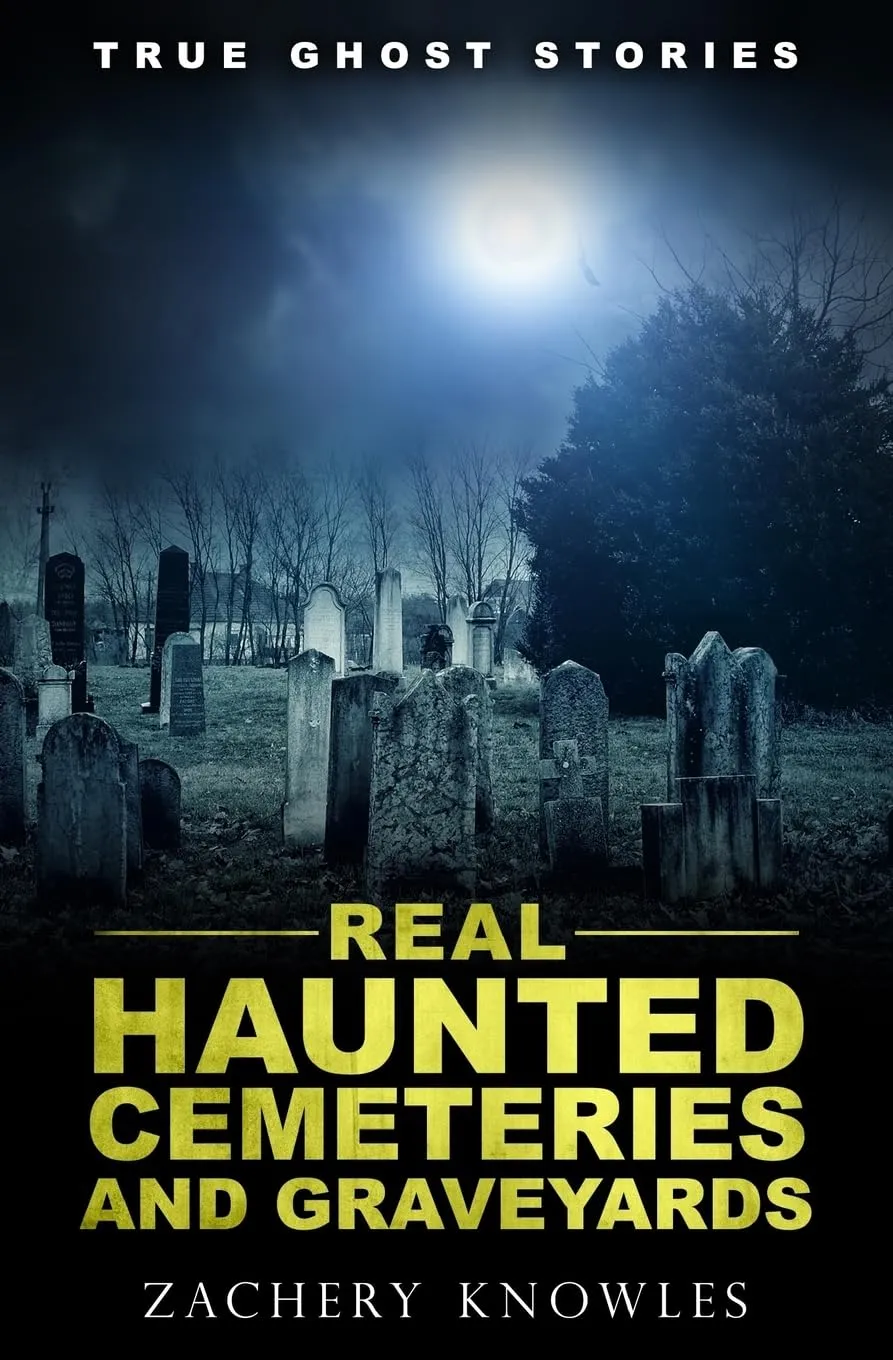
True Ghost Stories: Real Haunted Cemeteries and Graveyards
This 119-page paperback by Zachery Knowles collects real paranormal accounts from some of the world’s most haunted cemeteries and graveyards. From violent poltergeists in Scotland’s Greyfriars Kirkyard to hellhounds in Stull Cemetery (rumored gateway to Hell), and shadowy figures in London’s Highgate, it explores ghostly cowboys, cursed ancient spirits, phantom animals, and more across the US, UK, Ireland, Egypt, and beyond—true stories that reveal why these burial grounds remain restless.
Local Legends
The legends of Greyfriars Kirkyard come from centuries of oral tradition, school rituals, and Victorian storytelling. These tales connect the site’s tragic history with its modern reputation for eerie happenings.
The Awakening of the Mackenzie Poltergeist
The most infamous modern legend centers on the night in late 1998 when the spirit of Sir George Mackenzie was allegedly “awakened” by a desecration. According to local accounts, a homeless man seeking shelter from a winter storm forced open the iron doors of the Black Mausoleum.
While exploring the interior, he broke into the lower burial vault and accidentally crashed through a false timber floor. This floor concealed an ancient plague pit containing the skeletal remains of dozens of victims from the 16th century.
After falling into the pile of bones, the man ran from the tomb in terror, screaming into the night. People nearby, including someone walking a dog, said they saw a dusty, dirty figure running out of the graveyard gates.
Since that night, there have been many reports of a violent spirit near the tomb. Within months, so many visitors reported injuries that the City of Edinburgh Council sealed the mausoleum and closed off the Covenanters’ Prison to the public.
The Legend of Greyfriars Bobby
The most beloved legend from the kirkyard is about Greyfriars Bobby, a Skye Terrier whose story has been told in books and Disney movies. According to tradition, Bobby belonged to John Gray, an Edinburgh police nightwatchman known as “Auld Jock.” When Gray died of tuberculosis in 1858, the loyal dog followed the funeral to Greyfriars and refused to leave his master’s grave.
For the next 14 years, Bobby is said to have stayed by the grave, leaving only for his midday meal when the One O’Clock Gun sounded from Edinburgh Castle. The story became so well-known that in 1867, the Lord Provost of Edinburgh, Sir William Chambers, paid for Bobby’s license so he wouldn’t be put down as a stray.
Bobby died in 1872 and was buried just inside the cemetery gate, since he couldn’t be laid to rest in consecrated ground. Some modern historians, such as Jan Bondeson, question the details and suggest that there may have been two dogs or that Bobby was a stray cared for by locals. Still, the legend is a key part of the graveyard’s story.
The “Bluidy Mackenzie” Dare
Long before the poltergeist stories, Edinburgh schoolchildren, especially those from nearby George Heriot’s School, had a ritual involving Sir George Mackenzie’s tomb. For generations, kids saw the “Bloody” Lord Advocate as a kind of bogeyman.
To show their courage, students would sneak into the kirkyard at night or during lunch, go up to the Black Mausoleum, and chant: “Bluidy Mackenzie, come oot if ye daur, Lift the sneck and draw the bar!” The “sneck” is the door latch, and the “bar” is the iron bolt. This tradition shows that the fear of Mackenzie’s spirit was part of local folklore for more than 300 years before the 1998 events.
One version of the legend says a schoolboy once took the dare too far and accidentally locked himself inside the tomb. He was supposedly found the next morning, his hair white from fear.
The Stolen Skull of 2003
In June 2003, a bizarre event occurred that added a modern chapter to the cemetery’s legends. Two teenagers broke into the Mackenzie Mausoleum through a ventilation slot at the rear.
Once inside, they decapitated a corpse—believed by some to be Mackenzie himself, though more likely a relative—and were later caught by police playing football with the skull on the kirkyard grass.
This act of desecration led to the first use of the ancient Scottish legal charge of “Violation of Sepulchre” in over a century. Local paranormal enthusiasts believe this event significantly intensified the poltergeist attacks, as the entity was “insulted” by the disrespect shown to its physical remains.
Reported Ghosts
Although the poltergeist gets most of the attention, people say other ghosts also haunt the kirkyard. Many visitors have seen shadowy figures moving among the headstones after dark, often thought to be the spirits of Covenanters who died in the nearby prison.
Another frequently reported apparition is a White Lady, though her identity remains a subject of debate among local historians. Some believe she is a soul trapped by the graveyard’s grief.
Some witnesses have also seen white birds that appear and vanish suddenly, which some people see as a paranormal sign. The ghost of Greyfriars Bobby is said to show up through sounds like phantom barking or the feeling of a small animal brushing against someone’s legs.
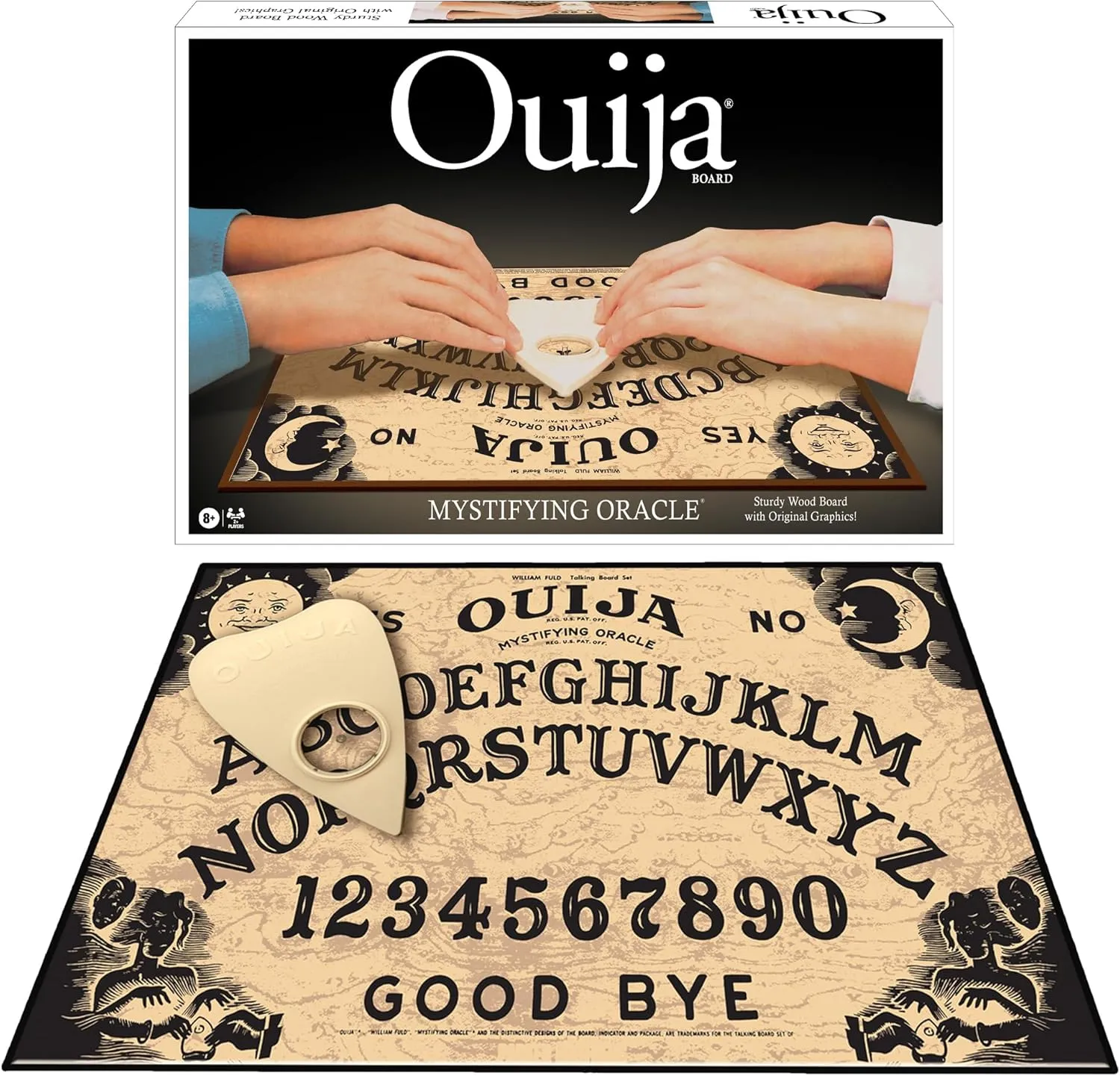
Premium Thick Wood Ouija Board by Winning Moves – Retro 1990s Design
paranormal favorite and Amazon’s Choice with over 9,200 glowing reviews (4.4/5 stars), this Winning Moves Ouija is praised by ghost hunters and enthusiasts for its thick wood build, nostalgic 1990s design, and smooth planchette action. Thousands call it the best for real spirit contact or fun scares—trusted for decades of eerie sessions.
Documented Sightings Timeline
| Witness | Date | Details |
| Local Criminal | Early 1800s | A man hiding from the law inside the Mackenzie Mausoleum claimed the coffins shifted and he heard “the breathing of a dead man” behind him. |
| George Heriot’s Students | 1850s–1990s | Multiple generations reported hearing banging from inside the tomb and feeling “icy fingers” after performing the “Bluidy Mackenzie” dare. |
| Unnamed Homeless Man | December 1998 | Accidentally broke into a plague pit beneath the Black Mausoleum; reported being “chased out” by a shadow with glowing eyes. |
| Unnamed Female Visitor | Early 1999 | The first modern “attack” report; the woman was found unconscious near the tomb with deep bruises around her neck. |
| Edinburgh Resident | 1999 | Reported being “blown back” from the mausoleum gates by a sudden, localized blast of freezing air that knocked her to the ground. |
| Colin Grant (Medium) | 2000 | Reported an “overwhelming malevolence” during a failed exorcism; died of a heart attack six weeks later. |
| Jan-Andrew Henderson | 2003 | The tour founder’s home, located next to the kirkyard, burned down in a fire with no identifiable cause, destroying all poltergeist records. |
| Two Teenagers | June 30, 2003 | Desecrated a corpse within the mausoleum; claimed they were “compelled” by a voice to commit the act. |
| Anonymous Tourist | 2004 | Photographed five large, red scratches on his neck that appeared instantly while standing outside the Covenanters’ Prison. |
| “Most Haunted” Crew | 2006 | During a live broadcast, multiple crew members felt “strangled,” and presenter Yvette Fielding reported a sharp blow to the back. |
| Unnamed Male Visitor | 2012 | Found to have a broken rib and “bite marks” on his shoulder after a night tour; he had no memory of the impact. |
| Various Tour Guests | 2015–2019 | Dozens of reports of cameras, mobile phones, and watches completely losing power or “dying” specifically at the Black Mausoleum. |
| Lee and Linzi Steer | September 2020 | Paranormal investigators recorded a “spirit box” session where the entity allegedly said “graveyard” and “burial” before appearing as a shadow on camera. |
| Tour Manager | October 2024 | Documented long, bright red scratches stretching the length of his arm while leading a Halloween tour group. |
| Anonymous Participant | February 2026 | Reported being “pushed hard” into a stone monument by an invisible force, resulting in significant bruising on the torso. |
Paranormal Activity
The paranormal activity at Greyfriars Kirkyard is known for being physically aggressive, making it one of the most well-documented cases of “assaultive” poltergeist activity anywhere. Since the late 1990s, the City of Edinburgh Council and tour operators have recorded over 500 reports of attacks on visitors.
Unlike most hauntings, which involve strange sights or sounds, the activity here often causes real physical injuries. People have reported deep scratches, round burns, and large bruises in places they couldn’t have reached themselves.
People often say these experiences build up over time. Witnesses describe a sudden drop in temperature, known as a “cold spot,” followed by the feeling of being watched or a sense that the air has become heavy.
These feelings often lead to physical contact. According to records from City of the Dead Tours, the most common experiences include:
- Physical Trauma: Deep, red scratches (often in sets of three), bite marks, and welts that appear on the neck, torso, and arms.
- Kinetic Force: Visitors reporting being pushed, shoved, or having their hair pulled by invisible hands.
- Physiological Collapse: An unusually high frequency of fainting spells, nausea, and sudden onset of respiratory distress specifically within the Black Mausoleum and the Covenanters’ Prison.
Witness Accounts and Testimonials
Numerous witnesses have provided detailed accounts of their encounters, many of which have been featured in documentaries and local news reports.
One visitor, Richard Falvey, described a typical encounter during a night tour:
“I felt a sharp, burning sensation on my back, like someone had dragged a hot needle across my skin. When I got back to the hotel and looked in the mirror, there were three long, angry red welts running from my shoulder blade down to my waist. I hadn’t bumped into anything, and I was wearing a thick leather jacket the whole time.”
Another witness, Anne-Marie, recounted a more extreme reaction during an interview regarding her visit to the Covenanters’ Prison:
“The air just went solid. I couldn’t breathe, and I felt this immense pressure on my chest as if someone was kneeling on me. I blacked out, and when I came to, I had bruises around my neck that looked exactly like fingerprints. The tour guide had to help me out of the gated area because I couldn’t walk.”
Over the years, patterns suggest the activity is “reactive.” It often gets worse when people taunt the spirit or when large groups enter restricted areas. Some visitors have even reported that the activity follows them home or to their hotels, with objects moving, phantom footsteps, and a lingering sense of dread for days after visiting the kirkyard.
Complete 11-Piece Ghost Hunting Kit – Everything for Beginner Paranormal Investigations
This all-in-one ghost hunting equipment kit provides the essential tools for exploring haunted locations:
- EMF meter (0-20+ mG range with activity level indicators)
- 8GB EVP recorder (up to 36 hours recording for capturing whispers/EVPs)
- Spirit box FM radio + portable speaker for real-time communication
- Infrared thermometer for spotting cold spots, UV flashlight for hidden evidence
- Brass detection rods and motion light-up cat balls to trigger spirit responses
- Shockproof carrying case with custom foam for easy transport
All the core tools you need in one convenient package.

Notable Investigations
Since activity increased in the late 1990s, Greyfriars Kirkyard has attracted many paranormal researchers. Unlike other places that rely mostly on stories, the events here have been carefully recorded by historians and investigators.
Jan-Andrew Henderson, a local historian and author, started City of the Dead Tours in 1999 and began keeping a detailed record of every physical incident reported by visitors. This log, with hundreds of entries about fainting, vomiting, and physical marks, is now the main database for researchers studying the Mackenzie Poltergeist.
In the early 2000s, the University of Edinburgh’s Koestler Parapsychology Unit conducted research in the kirkyard. The researchers usually look for environmental causes such as infrasound, electromagnetic fields (EMF), and carbon monoxide. Still, the large number of physical injuries reported at the site made it hard to explain them solely through normal psychological factors.
Investigators have often noticed that EMF meters show big spikes near the Black Mausoleum, even when there’s no obvious power source nearby.
The Exorcisms of Colin Grant
The most well-known and debated investigation was led by Colin Grant, a spiritualist minister and medium from the Spiritualist Church of Scotland.
In 2000, following an outcry over the rising number of injuries to tourists, Grant was invited to perform an exorcism to “cleanse” the kirkyard of its malevolent energy.
Grant conducted multiple sessions, during which he claimed to be overwhelmed by the spirits of the hundreds of Covenanters who died in the prison, as well as a singular, dominant evil entity he identified as Sir George Mackenzie.
During his last exorcism attempt in early 2001, witnesses said Grant looked very upset and shaken. He said the “evil” was too strong and that the spirits were “ripping him apart.” He even said he thought the job might kill him.
Grant eventually gave up, saying the site was too dangerous to cleanse. Six weeks later, he died suddenly of a heart attack. Many in the paranormal community believe his death was caused by his encounter with the Mackenzie Poltergeist. However, doctors said it was from natural causes.
Televised and Independent Studies
The kirkyard has also appeared in many well-known media investigations:
- Most Haunted Live: In 2006, the popular television program broadcast live from the cemetery. During the investigation, presenter Yvette Fielding and medium Derek Acorah claimed to encounter the spirit of Mackenzie. Members of the crew reported feeling physically ill, and several “EVP” (Electronic Voice Phenomena) recordings were reportedly captured in the Covenanters’ Prison.
- Scariest Places on Earth: This American show sent a family to spend the night in the kirkyard. The investigation ended early because the family became too scared to continue, saying they heard heavy footsteps and metal clanking inside the mausoleum.
- The Ghost Club: As one of the oldest paranormal research groups, they have held several vigils at Greyfriars. Their reports mention sudden temperature drops of up to 10 degrees in just seconds, especially near the entrance to the Black Mausoleum.
The Harry Potter Connection
Greyfriars Kirkyard is also interesting because of its connection to literature. Author J.K. Rowling often visited the graveyard while writing the Harry Potter books.
Several names on the gravestones in the kirkyard inspired her characters. The most famous is the grave of Thomas Riddell, which fans link to the real name of Lord Voldemort.
Other names on the monuments include William McGonagall and Elizabeth Moodie. While this is a literary link, not a paranormal one, the number of fans visiting has made the kirkyard one of Scotland’s most popular sites and a part of modern urban legend.
Tags:
Explore More Haunted Locations:
Poveglia Island (Venice, Italy)
January 29, 2026
Annesley Old Church (Nottinghamshire, UK)
January 8, 2026
Ancient Ram Inn (Gloucestershire, UK)
December 2, 2025
January 26, 2026
Ardvreck Castle (Sutherland, Scotland)
January 7, 2026
Myrtles Plantation (St. Francisville, LA)
February 24, 2026
