
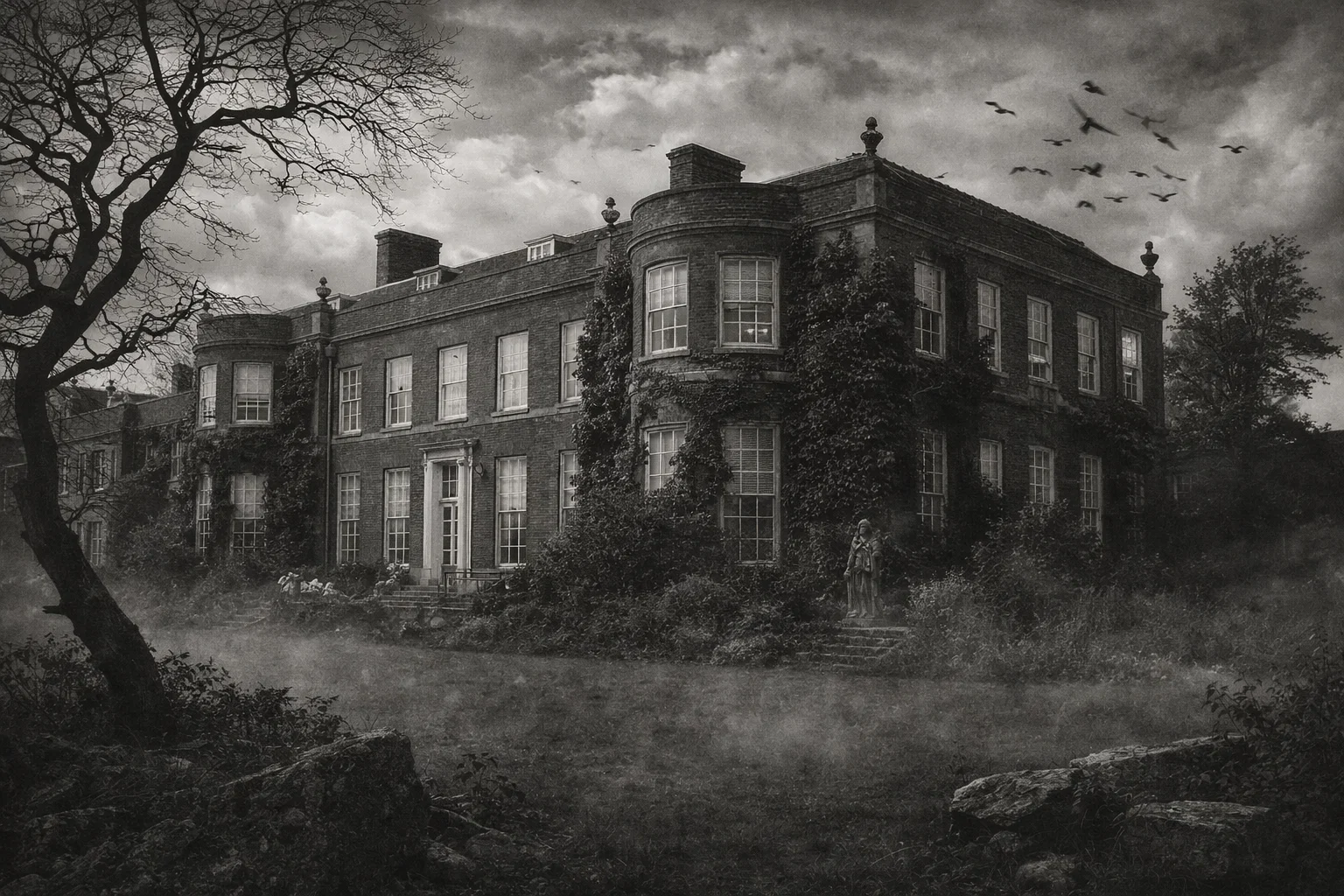

The Hinton Ampner haunting describes a series of strong paranormal events at a manor house in Hampshire in the mid-1700s. Many consider it one of the best-documented cases of poltergeist activity and ghost sightings in British history.
The haunting mainly affected Mary Ricketts and her family, who left the house because of the intense events. These included strange voices, ghostly figures, and loud, violent noises.
Summary
Overview
| Attribute | Details |
| Name | Hinton Ampner |
| Other Names | The Ricketts Haunting, The Hampshire Poltergeist House |
| Address | Hinton Ampner, Alresford SO24 0LA, Hampshire |
| Country | United Kingdom |
| Coordinates | 51.0519° N, 1.1444° W |
| Nearest City | Winchester |
| Property Type | Country Manor House |
| Built / Established | Original Tudor manor built c. 1540s; Current house built in 1793 |
| Closed/Abandoned | Still in use (The original haunted manor was demolished in 1793) |
| Owner | National Trust |
| Type of Haunting | Poltergeist, Apparitions, Residual |
| Manifestations | Screams, heavy footsteps, slamming doors, shadowy figures, gunshots, disembodied whispers |
| Tragic Events & Causes | Alleged illicit affair and hidden infant death involving Lord Stawell and his sister-in-law; discovery of a small skull during demolition. |
| Known Entities | Lord Stawell, Honoria Willoughby (The Woman in Silk) |
| Fear Rating | 7/10 (Highly Intimidating) [See Explanation] |
| First Recorded Sighting | 1765 (Mary Ricketts’ first reports) |
| Most Recent Sighting | 1960s – Reports of a “Grey Lady” in the newer 18th-century structure. |
| Activity Level | 4/10 (Mild Activity) [See Explanation] |
| Current Status | Open as a museum and gardens |
| Open to the Public? | Yes, visitors can access the house and gardens via National Trust membership or day tickets. |
| Best Time to Visit | Autumn (for atmosphere) or peak National Trust opening hours. |
| Danger Warning | Paranormal activity is largely historical; no significant physical dangers reported today. |
| Similar Haunted Locations | Borley Rectory, Epworth Rectory, 50 Berkeley Square, Ballechin House, Ancient Ram Inn, Ham House, Woodchester Mansion, Berry Pomeroy Castle, Chillingham Castle, Muncaster Castle, Samlesbury Hall, Smithills Hall. |
Hinton Ampner’s Haunted History
The dark history of Hinton Ampner centers on the Stawell family, who owned the estate in the 18th century. Before the Ricketts family moved in, the house was the residence of Lord Stawell, a man of reportedly dissolute character. Local rumors suggested that Lord Stawell engaged in a scandalous and illicit affair with his sister-in-law, Honoria Willoughby.
Locals and servants claimed that a child was born from this affair and either died or was hidden. Lord Stawell died in 1755, and Honoria Willoughby died soon after.
In 1765, William Henry Ricketts and his wife, Mary, moved in. The Ricketts family quickly began to experience strange events that became more violent over the next six years.
The haunting got so bad that servants would not stay in the house. Mary Ricketts began writing letters to her brother, Admiral John Jervis, to describe what was happening. The disturbances continued until the house was considered unlivable and was torn down in 1793.
When the house was demolished, workers reportedly found a small skull under the floorboards in one room. Some said it was a monkey skull, while others believed it was a child’s remains, adding to the stories of hidden crimes.
Journey to Earth’s Most Haunted Realms – National Geographic Supernatural Places
This beautifully produced hardcover book from National Geographic takes you on a global journey to over 100 legendary haunted and mysterious sites, blending breathtaking photography, eyewitness accounts, historical context, and folklore. From ancient cursed ruins to modern ghost hotspots, it’s an immersive guide to the planet’s most supernatural locations—ideal for armchair travelers and haunted site enthusiasts alike.
Local Legends
Stories about the Hinton Ampner haunting have been part of Hampshire folklore for centuries. They come from the village of Hinton Marsh’s oral traditions and the personal papers of the Ricketts and Jervis families. These legends are the main traditional explanation for the violent events at the manor.
The Illicit Secret of Lord Stawell and Honoria Willoughby
This most lasting legend is about the behavior of Lord Stawell and his sister-in-law, Honoria Willoughby. Local stories say that after Lady Stawell died, the two began a secret and scandalous relationship.
Folklore claims the haunting was caused by their “unresolved sin” and the guilt from their relationship. In some versions, their child was either killed or died as a baby and was hidden in the walls to protect Lord Stawell’s reputation.
Later residents called the heavy, rhythmic thumping “Lord Stawell’s Hammer.” People said it was the Lord’s spirit pacing the floor, restless because of his hidden crimes.
The Hidden Infant and the Skull of the Yellow Room
Much of Hinton Ampner’s legend centers on the Yellow Room. Stories claimed a child was either buried alive or hidden after death under the floorboards of this room.
This story seemed more believable after the manor was demolished in 1793. Local records say workers found a small skull in a box under the Yellow Room’s floor. Some skeptics thought it was a monkey’s skull, but most locals believed it was the Stawell-Willoughby child.
The legend continues that the high-pitched, baby-like cries heard by the Ricketts’ nursemaids were from this “hidden child” wanting a proper burial.
The “Woman in Silk” and the Rustling Specter
Local people and former servants kept telling the story of the “Woman in Silk,” thought to be Honoria Willoughby’s ghost. Unlike many scary spirits, she was described as a “residual shadow” who repeated her daily habits.
According to the legend, people could hear her silk dress rustling as she moved from the bedrooms to the library. The most detailed part of the story says she would appear at the kitchen door as a tall, dignified woman, stare at the servants with “profound indifference,” and then disappear.
The “Grey Lady” of the New Manor
Although the original house was torn down, new legends have grown around the 1793 building and its gardens. Since the National Trust took over, visitors and staff have sometimes reported seeing a “Grey Lady” walking near the old Tudor foundations.
Modern stories say that even though the house was destroyed, the land is still cursed. In the late 1900s, people reported seeing a woman in grey near the bushes and old stables. This led some to believe the “Woman in Silk” changed her appearance over time to fit each era.
The Legend of the “Invisible Intruder”
Another, less common local story is about the “Invisible Intruder.” This legend began after reports of doors being unbolted from the inside and of heavy furniture moving on its own.
In the 1700s, local gossip claimed the house was built on a “ley line,” or spiritual crossroads, allowing different spirits to pass through. This story explained why the Ricketts family often heard crowds talking and laughing in the dining room, yet always found it empty and the doors locked.
Premium Thick Wood Ouija Board by Winning Moves – Retro 1990s Design
paranormal favorite and Amazon’s Choice with over 9,200 glowing reviews (4.4/5 stars), this Winning Moves Ouija is praised by ghost hunters and enthusiasts for its thick wood build, nostalgic 1990s design, and smooth planchette action. Thousands call it the best for real spirit contact or fun scares—trusted for decades of eerie sessions.
Reported Ghosts
People at Hinton Ampner often saw and heard strange things. Mary Ricketts and her brother both said they saw a man in a plain coat who looked a lot like the late Lord Stawell. This entity was often seen going into the “Yellow Room” or the library, then disappearing through the walls.
Another often-reported ghost is the “Woman in Silk.” People described hearing a silk dress rustling in the halls, then seeing a woman, usually thought to be Honoria Willoughby.
In the newer 1793 house, people still sometimes see a “Grey Lady” in the gardens and some hallways, suggesting some energy from the old manor remains.
Ricketts Family Letters
The most comprehensive evidence for the haunting is found in a primary source: a manuscript called “Narrative of the Strange Events at Hinton Ampner,” which Mary Ricketts wrote in 1772 for her children.
In her letters, Mary talks about the mental strain the haunting caused, saying she often kept her fears “in her own bosom” so people wouldn’t think she was superstitious. She described an occasion on April 2, 1771, the anniversary of Lord Stawell’s death, when the activity reached a terrifying crescendo of footsteps and door-slamming in the locked Yellow Room.
On the nature of the auditory phenomena:
“Frequently in the middle of the night I have heard the noise of a hollow murmuring, that seemed to come from a distance and to die away; then it would break out again, as if many people were talking at once, but the sound was too indistinct to admit of any words being understood. At other times I have heard the sound of footsteps in the lobby and upon the stairs, when I knew that every person in the house was in bed.”
Regarding the anniversary of Lord Stawell’s death (April 2, 1771):
“I was awakened by a loud noise that seemed to be in the next room, like the falling of a very heavy weight. I immediately got out of bed and went into the room, but found nothing. I had hardly returned to my own bed when I heard a sound like the slamming of a door with great violence. This was followed by a deep groan, and then all was still.”
Describing the apparition in the library:
“I saw a man in a drab-coloured coat, with a wig on, standing at the window. He was looking out into the garden. I was so surprised that I stood still for a moment, and then he turned and looked at me. His face was pale and thin, and he had a very melancholy expression. I went towards him, but before I could reach him he vanished.”
The final letter before they left the house:
“My brother, after having passed the night in the house, was so perfectly convinced of the reality of the disturbances, and of the impossibility of their being produced by any human means, that he strongly urged me to quit it as soon as possible.
He said that he should never feel at ease while my children and I remained in a place where such unaccountable things were constantly happening. I was myself so much exhausted by the anxiety and terror I had undergone, and my health was so much impaired, that I determined to follow his advice.
Accordingly, on September 20, 1771, I left Hinton Ampner forever. I cannot describe the relief I felt when I found myself at a distance from that house, which had been for six years the scene of so much misery to me.
I have since heard that the disturbances continued with even greater violence after I left, until the house was at length pulled down. I have now given a faithful account of all that happened to me during my residence there; and I can only add that, however strange and incredible it may appear, it is nevertheless strictly true.”
Her letters were so detailed that they became a main source for a 1872 article in The Gentleman’s Magazine, helping to make the house famous as one of England’s most haunted.
Documented Sightings Timeline
| Witness | Date | Details |
| Elizabeth Pole | 1765 | Reported hearing heavy footsteps and the sound of someone walking through her bedroom. |
| Mary Ricketts | 1769 | Observed a man in a drab coat standing by the window of the library; he vanished when approached. |
| Nursemaid | 1770 | Claimed to see a female figure in a silk dress standing over the children’s bed. |
| Captain John Jervis | 1771 | Investigated the house and heard “immense noises” like gunshots and falling timber throughout the night. |
| Mary Ricketts | 1771 | Reported three distinct knocks on her headboard and the sound of hollow groans. |
| Demolition Crew | 1793 | Found a small skull in a box under the floorboards of the manor. |
| National Trust Staff | 1960s | Anecdotal reports of a phantom woman seen in the gardens near the site of the old manor. |
Complete Home Cleansing Smudging Kit – White Sage, Palo Santo, Abalone Shell & More
This all-in-one smudging kit is designed for spiritual cleansing and energy clearing in haunted or negative spaces. It includes two California white sage bundles, three Palo Santo sticks, a beautiful 5-6 inch abalone shell with wooden stand, a natural turkey feather for directing smoke, rose quartz and amethyst crystals, plus a detailed instruction guide with blessings—everything needed to perform traditional smudging rituals for protection and positive energy.

Paranormal Activity
The haunting at Hinton Ampner was known for its loud noises. It started with simple footsteps and grew louder, sometimes sounding like “a thousand bricks falling” or like doors slamming hard.
These loud sounds often seemed to respond to people’s actions, copying what the residents did. The haunting was unusual because it happened almost every night for years, which is rare for such intense cases.
Notable Investigations
The Jervis-Luttrell Investigation (1771)
The most famous investigation was led by Captain John Jervis (who later became the Earl of St. Vincent) and Colonel James Luttrell (later the Earl of Carhampton). Jervis came to the house in 1771 to protect his sister, Mary Ricketts, and to prove the haunting was a trick.
He and Luttrell were equipped with pistols and swords for protection. They meticulously patrolled the house, locking every door and window with wax seals to detect tampering. Throughout the night, Jervis reported hearing a “tremendous noise” like the sound of the entire house falling. He felt a presence “flit past him” in the lobby.
Even with their careful watch, they found no intruders and no broken seals. Jervis then officially said the house was “unfit for any Christian to live in.”
The Duthy Inquiry and the “Servant” Theory (1839)
Historian John Duthy later investigated the case for his book Sketches of Hampshire. He spoke with locals who said John Jervis had come back for a second, secret investigation.
Duthy’s sources claimed that Jervis caught a female servant dragging a heavy weight and chains to fake the haunting. But this idea is debated. Mary Ricketts’ letters and Ralph Dutton’s later research say the events, like noises heard by neighbors and things happening in locked rooms, were too complicated for one servant to pull off for six years without being caught.
The Harry Price Historical Review (1945)
Well-known paranormal researcher Harry Price wrote about Hinton Ampner in his 1945 book, Poltergeist Over England. He studied the case by looking at the original Ricketts manuscripts and the Jervis family’s accounts.
He decided the case was one of the most believable in British history because the witnesses were respected and had strong reputations. Price pointed out that moving objects and repeated noises were classic signs of a poltergeist. He also said that finding the skull during demolition gave the ghosts a “psychical focus.”
The Society for Psychical Research (SPR) Analysis
The Society for Psychical Research has studied the Hinton Ampner case through various committees since its founding in 1882. Researchers such as Edmund Gurney and Frederic W.H. Myers looked at Mary Ricketts’ story as part of their work on “veridical” (truthful) hauntings.
They found the Hinton Ampner stories unique because the witnesses did not want attention. Mary Ricketts even kept her diary private during her life to protect her family’s reputation, which made her descriptions seem more believable.
Tags:
Explore More Haunted Locations:
Ardvreck Castle (Sutherland, Scotland)
January 7, 2026
Stanley Hotel (Estes Park, CO)
February 11, 2026
Epworth Rectory (Lincolnshire, UK)
January 14, 2026
Annesley Old Church (Nottinghamshire, UK)
January 8, 2026
Ashbourne House (New South Wales, AU)
December 4, 2025
Gainesridge Dinner Club (Camden, AL)
January 23, 2026
