
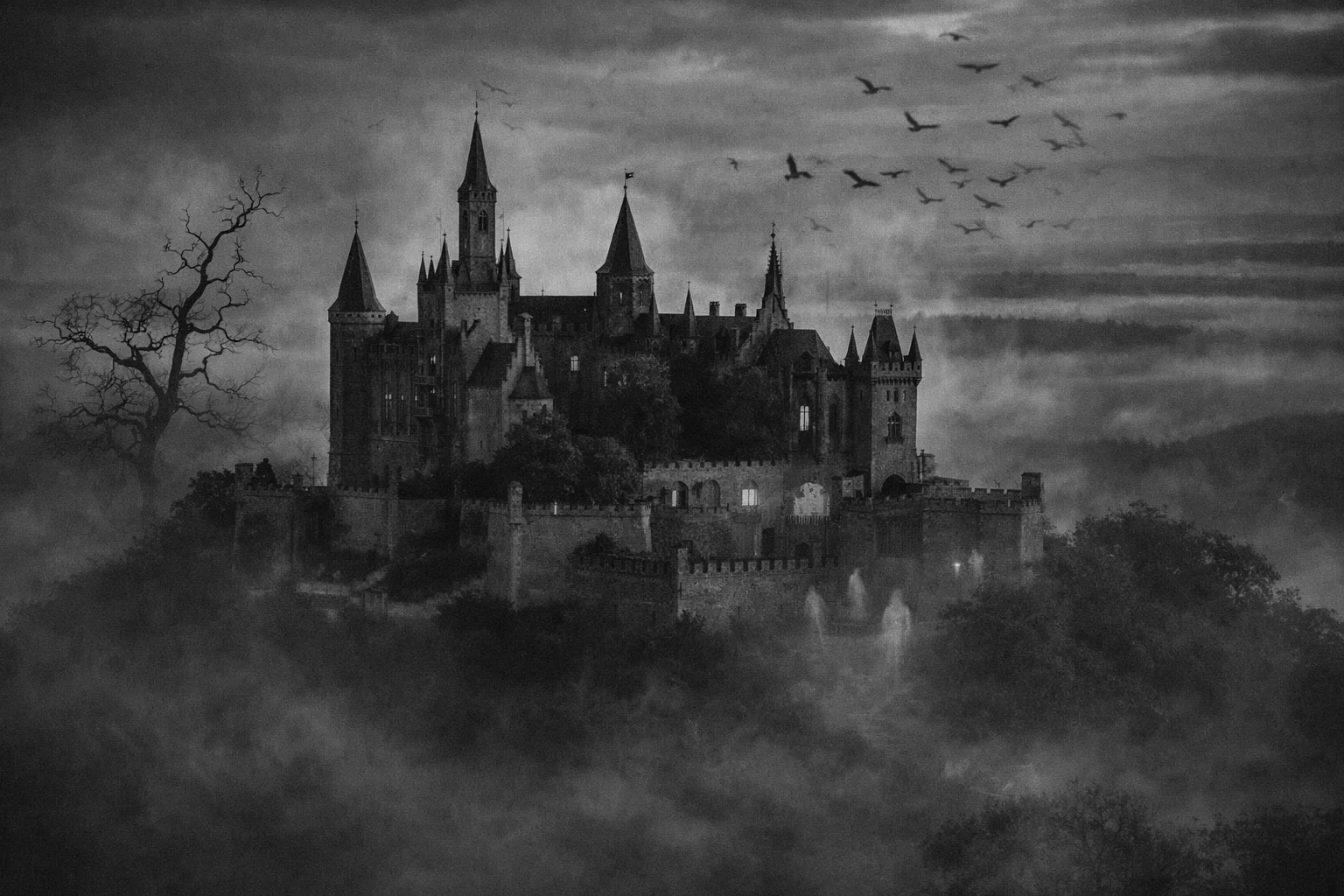

The haunting of Hohenzollern Castle centers on the White Lady, a ghostly figure said to warn of death in the Hohenzollern family. According to legend, she appears in the castle’s halls just before a family member dies or disaster strikes. Most stories link her to a 14th-century noblewoman whose life ended in sorrow and repentance.
Summary
Overview
| Attribute | Details |
| Name | Hohenzollern Castle |
| Other Names | Burg Hohenzollern, Ancestral Seat of the Imperial House of Hohenzollern |
| Address | 72379 Burg Hohenzollern, Bisingen, Baden-Württemberg |
| Country | Germany |
| Coordinates | 48.3232° N, 8.9677° E |
| Nearest City | Hechingen |
| Property Type | Medieval castle reconstruction |
| Built / Established | 11th Century (original structure), 1867 (current structure) |
| Closed/Abandoned | Still in use |
| Owner | Georg Friedrich, Prince of Prussia |
| Type of Haunting | Apparitions, Crisis Apparitions |
| Manifestations | Shadowy figures, footsteps, cold drafts, moving objects, visual apparition of a woman in white |
| Tragic Events & Causes | Alleged filicide in the 14th century, repeated destruction of previous castle iterations during sieges and wars |
| Known Entities | The White Lady (Kunigunde von Orlamünde), The Phantom King (Frederick the Great) |
| Fear Rating | 4/10 (Mildly Unsettling) [See Explanation] |
| First Recorded Sighting | 15th Century (folklore origins), 1598 (first documented court report) |
| Most Recent Sighting | 20th Century – Soldiers reported a veiled white figure shortly before an officer’s death |
| Activity Level | 3/10 (Mild Activity) [See Explanation] |
| Current Status | Open as a museum and private residence |
| Open to the Public? | Yes, visitors can purchase tickets for the grounds and showrooms |
| Best Time to Visit | October–November (atmospheric mist and seasonal events) |
| Danger Warning | No specific physical dangers; strictly enforced security and steep terrain |
| Similar Haunted Locations | Berlin Palace, Plassenburg Castle, Spandau Citadel, Wolfsegg Castle, Burg Eltz, Neuschwanstein Castle, Heidelberg Castle, Wewelsburg Castle, Houska Castle, Windsor Castle, Hampton Court Palace, Edinburgh Castle, Bran Castle, Moosham Castle, Leap Castle, Chillingham Castle |
Hohenzollern Castle’s Haunted History
Hohenzollern Castle has a history marked by destruction, hardship, and family tragedy. The current castle is actually the third built on this site, after two earlier versions were destroyed during violent sieges and times of great suffering.
The First Castle and the Great Siege of 1423
The first fortress, known as “Castro Zolre” in 1267, was once called the “crown of all castles in Swabia.” Its strong reputation eventually led to a major conflict with the Swabian League of Cities.
After a brutal ten-month siege in 1423, the castle’s defenders were starved into surrender. Instead of just taking the castle, the victors tore down every stone to make sure the Hohenzollerns could never come back.
The defeat and later imprisonment of Burgrave Friedrich XII, called “der Öttinger,” marked the first big downfall of the family at this castle.
Journey to Earth’s Most Haunted Realms – National Geographic Supernatural Places
This beautifully produced hardcover book from National Geographic takes you on a global journey to over 100 legendary haunted and mysterious sites, blending breathtaking photography, eyewitness accounts, historical context, and folklore. From ancient cursed ruins to modern ghost hotspots, it’s an immersive guide to the planet’s most supernatural locations—ideal for armchair travelers and haunted site enthusiasts alike.
The Second Castle and the Thirty Years’ War
A second, stronger castle was built in 1454. It faced heavy fighting during the Thirty Years’ War. In 1634, after a nine-month-long siege, Württemberg troops took the castle. Records describe how the defenders suffered, running out of food and supplies before finally giving up.
After the war, the Habsburgs controlled the castle for almost a hundred years. In the winter of 1744/45, French soldiers took over during the War of the Austrian Succession. They faced a harsh winter on the mountain. By 1798, the last Austrian owner left, and the castle fell into ruin, with only the Chapel of St. Michael remaining.
Modern Tragedies and Royal Burials
Even the current castle, finished in 1867, carries reminders of its troubled past. King Frederick William IV of Prussia, who dreamed up the Neo-Gothic design, died in 1861 and never saw it completed. Later, the castle served as the Hohenzollerns’ last refuge when the Third Reich fell.
In 1945, Crown Prince Wilhelm and Crown Princess Cecilie escaped the advancing Soviet Army by fleeing to the castle. Both died in the early 1950s and are buried in the castle’s small cemetery, since their family estates in Potsdam and Brandenburg were cut off behind the Iron Curtain.
The Legend of the Infanticide
One of the darkest and most lasting stories tied to the castle is the legend of Countess Kunigunde von Orlamünde. Born in 1303, she became a widow and grew desperately obsessed with Albrecht of Nuremberg.
Because of a tragic misunderstanding—she thought his mention of “four eyes” meant her children, not his parents—she is said to have killed her two young children. Some stories say she used a golden needle to pierce their skulls so there would be no visible wounds.
This act of killing her own children is said to be the origin of the White Lady curse, which has supposedly predicted the deaths of Prussian kings and German emperors for more than five hundred years.
Local Legends
The legends of Hohenzollern Castle are closely linked to the history of the Hohenzollern family and the folklore of the Swabian Alps. These tales have been carefully preserved in German records and oral traditions, offering a supernatural explanation for changes in the royal family.
Although historians debate some details, these stories remain important to the castle’s identity because locals and staff continue to share them.
Complete Home Cleansing Smudging Kit – White Sage, Palo Santo, Abalone Shell & More
This all-in-one smudging kit is designed for spiritual cleansing and energy clearing in haunted or negative spaces. It includes two California white sage bundles, three Palo Santo sticks, a beautiful 5-6 inch abalone shell with wooden stand, a natural turkey feather for directing smoke, rose quartz and amethyst crystals, plus a detailed instruction guide with blessings—everything needed to perform traditional smudging rituals for protection and positive energy.

The Fatal Misunderstanding of Kunigunde von Orlamünde
The most famous legend is about Countess Kunigunde von Orlamünde, a 14th-century noblewoman. After her husband, Count Otto VI, died, she fell in love with Burgrave Albrecht of Nuremberg, who belonged to the Hohenzollern family.
According to tradition, Albrecht wanted to turn her down without causing a scandal, so he told her he would marry her if not for “four eyes” between them. He meant his parents, who did not approve, but Kunigunde thought he was talking about her two children—a son and a daughter.
Desperate to marry him, she supposedly used a golden needle to kill her children in a way that left no visible marks. When she told Albrecht the problem was solved, he was horrified by what she had done and rejected her.
To make up for her crime, Kunigunde went on a pilgrimage to Rome. When she came back, she founded the Cistercian monastery of Himmelsthron and became a nun. Since the Cistercian habit is white, people say her ghost appears in a pale, flowing robe.
This story is considered the origin of the White Lady, who is believed to haunt every Hohenzollern castle as a restless spirit seeking forgiveness.
The Omen of the Black Gloves
One unique part of Hohenzollern folklore is that the White Lady’s appearance changes to show how serious an event will be. Court records from the 1600s and 1700s say she does not always look the same. Witnesses claim the color of her gloves is a supernatural sign for the castle’s residents.
If she is seen wearing white gloves, it usually means a birth, a wedding, or good times are coming for the family. But if she appears with black gloves, it is taken as a sure sign of death or disaster.
This legend became especially popular in 1840, when people claimed to have seen a figure in black gloves in the halls just before King Frederick William III died. The story goes that the spirit is bound by her need for penance to warn her descendants, whether by blood or by title, of coming death.
The Guardian Drummer of the Ramparts
While the White Lady is seen as a sign of family tragedy, the Headless Drummer legend centers is protecting the castle from external threats.
This story goes back to the many sieges the castle faced in the Middle Ages and during the Thirty Years’ War. Local tales say a young drummer boy was executed—maybe for desertion or not warning of a surprise attack—and was beheaded on the castle walls.
In the years since, visitors and guards have reported hearing the muffled sound of a drum beating a military march from the castle walls, especially during national crises or when it is foggy.
Unlike the quiet sadness linked to the White Lady, the Headless Drummer is said to be loud and hard to ignore. The legend says his drumming gets louder as danger approaches, serving as a “phantom alarm” even though the castle is no longer a military stronghold.
Premium 4-Pack 3D Changing Face Horror Portraits for Halloween
This set of four large lenticular portraits features classic Victorian-style figures that magically transform from innocent, normal faces to horrifying ghostly or monstrous expressions as you move past them. Using 3D illusion technology, these framed pictures create a chilling “watching eyes” effect perfect for turning any room or hallway into an instantly haunted atmosphere.

The Midnight Inspection of Frederick the Great
King Frederick the Great died at Sanssouci, but his remains were kept at Hohenzollern Castle for several decades in the 20th century to keep them safe during World War II.
During this time, a new legend grew among the castle’s night watchmen. They claimed that the spirit of the Old Fritz, as he was called, would leave his casket at midnight to inspect the castle’s armory and chapels as a ghost.
People described seeing a short, thin figure in a dusty blue uniform and a tricorne hat, leaning on a walking stick. Many reported hearing the stick tapping on the stone floors of the Genealogy Hall.
Even after his remains were moved back to Potsdam in 1991, some locals say a “residual” presence of the King still lingers. They believe he was such a strong defender of the Hohenzollern legacy that he would never really leave the family’s ancestral home.
Reported Ghosts
The main ghost at the castle is the White Lady, described as tall and thin with a pale, sad face. People often see her gliding through the Genealogy Hall or the Count’s Hall, looking like a see-through figure in a white gown and veil. Witnesses usually feel sadness or dread, not fear or anger.
In addition to the White Lady, people also report seeing a Headless Drummer. He is said to appear on the castle walls during wars. While the White Lady is a sign for the family, the drummer is seen as a guardian spirit whose drumming warns everyone in the castle of coming enemies.
Documented Sightings Timeline
| Witness | Date | Details |
| Count Frederick I | 11th Century | Earliest legendary encounter; a white lady appeared at the castle gates demanding admittance after the Count’s horse mysteriously vanished. |
| Castle Servants | 1486 | Recorded appearance of a white figure in the residential quarters, followed by a period of local misfortune. |
| Court Officials | 1540 | The apparition was reported moving through the fortifications during a time of political tension. |
| Garrison Guards | 1554 | A silent woman in white was seen on the ramparts shortly before the castle faced military threats. |
| Elector Johann Georg | 1598 | The Elector reportedly encountered the White Lady on New Year’s Day; he died eight days later. |
| Elector Johann Sigismund | 1619 | The Elector witnessed a veiled figure gliding through the walls of his chambers; he died in December of that year. |
| Palace Courtier | 1667 | A courtier under the Great Elector reportedly fell down a staircase after being startled by an encounter with the specter. |
| Royal Household | 1677 | A documented sighting of the White Lady coincided with a series of tragic family illnesses. |
| King Frederick I | 1713 | The King reportedly saw the White Lady in his final days, viewing it as a certain sign of his approaching end. |
| Sentry at Pillnitz | 1857 | A soldier reported a woman in white leading four headless men carrying a casket; King Frederick William IV suffered a stroke shortly after. |
| Military Sentries | 1940 | German soldiers stationed at the castle reported a veiled white figure in the empty hallways hours before a high-ranking officer’s sudden death. |
| Castle Visitors | 1970s | Anecdotal reports of a woman in 14th-century white robes seen standing near the Chapel of St. Michael. |
| Night Watchmen | 1980s | Multiple reports of rhythmic tapping sounds and a short silhouette in military dress (the Phantom King) near the armory. |
| Museum Staff | Modern Era | Frequent reports of cold spots and the sound of rustling silk in the State Apartments after the castle is closed to the public. |
Advanced P-SB7 Spirit Box – Essential Tool for Real-Time EVP Sessions
Unlock clearer spirit communication with the latest P-SB7 Spirit Box, packed with investigator-friendly features:
- Adjustable sweep speeds (including ultra-fast 50ms) and forward/reverse directions
- Built-in ATDD temperature deviation detection (±5°F alerts for cold spots)
- Noise reduction for cleaner audio, plus AM/FM selection
- Backlit display, built-in flashlight, and loud speaker for dark investigations
- Compact design with 1-year warranty and batteries included
Ideal for scanning haunted sites and capturing potential responses instantly.

Paranormal Activity
Paranormal activity at Hohenzollern Castle tends to happen at certain times, not randomly. These events usually occur during big changes for the Hohenzollern family. The activity is often subtle, like cold drafts, small objects moving on their own, or the sound of ghostly footsteps on stone floors.
Over the years, people have noticed that sightings of the White Lady often happen when thick mountain fog rolls in. Skeptics say these are just optical illusions caused by the mist.
However, staff and visitors still report feeling watched by something unseen, especially in the castle’s quieter areas, such as the casemates and the chapel.
Notable Investigations
No public records show that professional or televised paranormal investigations, like those by Ghost Hunters International, have taken place at Hohenzollern Castle.
Because it is a private home for the Hohenzollern family and an important cultural site, the owners usually do not allow formal paranormal research there.
Tags:
Explore More Haunted Locations:
Marion Military Institute (Marion, AL)
January 19, 2026
January 27, 2026
Ancient Ram Inn (Gloucestershire, UK)
December 2, 2025
Alcatraz Island (San Francisco, CA)
December 1, 2025
Gainesridge Dinner Club (Camden, AL)
January 23, 2026
Ardvreck Castle (Sutherland, Scotland)
January 7, 2026
