
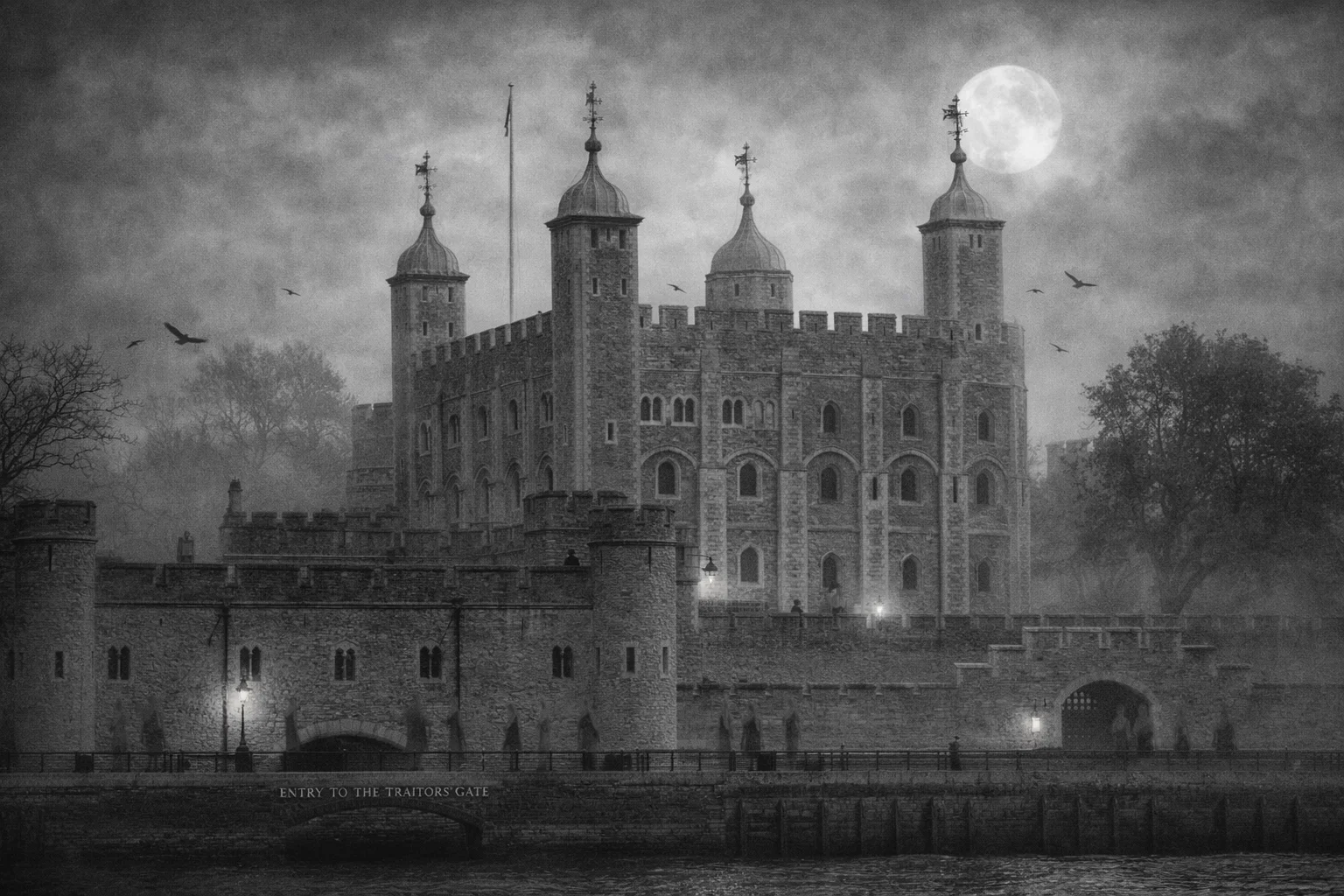

The Tower of London is famous for stories of ghosts and strange events linked to those who were once imprisoned or executed there. Built in the 11th century, its long history of intrigue and violence is thought by many to have left a lasting mark. Reports of royal ghosts and unexplained experiences have made it one of the world’s most well-known haunted places.
Summary
Overview
| Attribute | Details |
| Name | Tower of London |
| Other Names | Her Majesty’s Royal Palace and Fortress, The Tower, The White Tower |
| Address | London EC3N 4AB |
| Country | United Kingdom |
| Coordinates | 51.5081° N, 0.0759° W |
| Nearest City | London |
| Property Type | Medieval castle, Royal palace, Fortress, and Prison |
| Built / Established | 1078 (Construction of the White Tower) |
| Closed/Abandoned | Still in use (as a museum and royal residence) |
| Owner | The Crown (Managed by Historic Royal Palaces) |
| Type of Haunting | Residual, Intelligent, Apparitions |
| Manifestations | Shadowy figures, footsteps, scent of perfume, physical pushing, screams, cold spots |
| Tragic Events & Causes | Executions of queens, suspected murder of child princes, political imprisonment, and torture. |
| Known Entities | Anne Boleyn, the Princes in the Tower (Edward V and Richard, Duke of York), Lady Jane Grey, Henry VI, Margaret Pole, the White Lady, Old Martin (the phantom bear). |
| Fear Rating | 6/10 (Moderately Frightening) [See Explanation] |
| First Recorded Sighting | 1241 (The ghost of St. Thomas Becket) |
| Most Recent Sighting | 2025 – Reports from night staff regarding unusual light patterns in the Chapel of St. Peter ad Vincula. |
| Activity Level | 8/10 (High Activity) [See Explanation] |
| Current Status | Open as a museum and UNESCO World Heritage Site |
| Open to the Public? | Yes, accessible via daily paid tours and general admission. |
| Best Time to Visit | Winter months for twilight tours (peak atmosphere). |
| Danger Warning | Steep, uneven stone stairs and low-light areas within the ancient towers. |
| Similar Haunted Locations | Hampton Court Palace, Edinburgh Castle, Warwick Castle, Lancaster Castle, Chillingham Castle, Leap Castle, Berry Pomeroy Castle, Dover Castle, Carlisle Castle, Stirling Castle, Windsor Castle, Bodmin Jail, Crumlin Road Gaol, Beaumaris Gaol, Shepton Mallet Prison, Oxford Castle & Prison. |
Tower of London’s Haunted History
William the Conqueror built the Tower of London in 1066. For almost a thousand years, it has been at the center of England’s most violent political changes. Although it started as a royal palace and fortress, its location near the heart of power made it the main place to hold people seen as “enemies of the state.”
The Tower’s history was especially intense from the 15th to the 17th centuries. During this time, it became known for official executions and secret killings.
The White Tower is the oldest part of the fortress and was a place of great suffering. During the Tudor period, under Henry VIII and Elizabeth I, the basement was used for interrogations. Records show that torture devices like the rack, the Scavenger’s Daughter (which compressed the body), and iron manacles were used there.
One recorded case is that of Jesuit priest John Gerard, who was hanged by his wrists for hours in 1597 to force him to name Catholic conspirators. The mental strain of these sessions, along with the deaths of those who did not survive, is often mentioned as the reason for the “heavy” feeling many visitors report today.
Much of the Tower’s haunted reputation comes from the Bloody Tower, which was once called the Garden Tower. It got its new name after the 1483 disappearance of the Princes in the Tower, Edward V and Richard, Duke of York.
After King Edward IV died, the boys were declared illegitimate and placed in the Tower’s inner rooms by their uncle, who became Richard III. They were never seen alive again. In 1674, workers found a wooden chest with two small skeletons buried under a staircase in the White Tower. This discovery gave real evidence to the old stories of ghostly children seen around the Tower.
Tower Green was used for private executions instead of the public ones on Tower Hill. Only seven important prisoners were allowed to die inside the Tower to avoid public unrest. These included Anne Boleyn in 1536, Catherine Howard in 1542, and Lady Jane Grey, who was just seventeen, in 1554.
These executions were often preceded by weeks of severe mental stress. For example, Anne Boleyn was kept in the same royal rooms she had used for her coronation just three years earlier, which historians say made her imprisonment even more cruel.
The Tower continued to be a place of execution into modern times. During World Wars I and II, it was used to execute spies. The last person executed there was Josef Jakobs, a German spy, who was shot by a firing squad in August 1941. He had to sit in a chair for his execution because he broke his ankle when he landed by parachute.
Highly-Rated True Ghost Stories: Real Haunted Hospitals and Mental Asylums
Explore terrifying real paranormal accounts in this compact yet gripping book:
- 88 pages of 13 documented hauntings from global locations (USA, Singapore, Germany, and more)
- Covers infamous sites like Waverly Hills, Old Changi Hospital, and Beelitz-Heilstätten
- Details historical suffering, ghostly apparitions, screams, and shadowy figures
- Part of the popular “True Ghost Stories” series (17 books total)
- Paperback format, published 2015—easy to read in one chilling sitting
Ideal for deepening your knowledge of haunted medical history.
Local Legends
The Tower of London has inspired many legends that try to explain the reported hauntings inside its walls. These stories come from its long history of political executions and royal tragedies, and many have been told for centuries by guards and residents.
The Headless Queen of the Chapel Royal
One of the most famous legends is about Anne Boleyn, who was executed in 1536. People who live in the Tower say her ghost does not just wander but follows a set path.
On some nights, people say a ghostly light flickers in the Chapel of St. Peter ad Vincula. Witnesses, including a guard captain in the late 1800s, have reported seeing a silent procession of knights and ladies in Tudor clothing walking down the aisle.
Leading this somber group is a woman recognized as the Queen, often described as carrying her head under her arm. She leads them to the altar, near where she was buried, before the whole scene disappears into the floor.
The Final Flight of Margaret Pole
The story of Margaret Pole, Countess of Salisbury, is one of the Tower’s most violent tales. On May 27, 1541, the seventy-year-old countess was taken to the scaffold. The legend says she insisted she was innocent, refusing to put her head on the block and saying, “So should traitors do, and I am none.”
When the executioner, called a “blundering youth” in records, swung his axe, he missed and hit her shoulder instead of her neck. The countess is said to have jumped from the block and was chased around the scaffold as the executioner struck at her again and again until she died.
Local legend says that on the anniversary of her death, people can hear a woman’s screams and the sound of an axe echoing across Tower Green, as if the ghostly struggle happens again and again.
The Pacing King of Wakefield Tower
A legend from the Wakefield Tower tells of Henry VI, who was murdered there in 1471 during the Wars of the Roses. History says he was killed while praying in a small chapel. The story describes a sad, robed entity who appears at midnight on the anniversary of his death.
The King is said to walk back and forth in the room, looking deeply sad and holding his hands as if in prayer. He keeps pacing until midnight ends, then slowly disappears into the stone walls, not to return until the next year.
Zak Bagans’ Ghost-Hunting For Dummies – 448-Page Step-by-Step Manual
Written by Zak Bagans, star of Ghost Adventures and founder of the Haunted Museum, this 448-page paperback is the ultimate beginner-to-advanced guide to paranormal investigating. It covers the history of ghost hunting, choosing haunted locations, using scientific tools and cameras, conducting safe investigations, and interpreting evidence—complete with real stories from Bagans’ famous cases.
The White Lady of the White Tower
The White Tower is said to be haunted by the White Lady, whose identity is unknown. Unlike the royal ghosts, no one knows who she was, but people who see her are convinced she is real. One story says a group of children saw her waving from a window in a locked room.
People say her appearance is almost always announced by a strong, sweet perfume that fills the air. Guards in St. John’s Chapel have reported the smell can be so strong it makes them feel sick, which they take as a sign the White Lady is right behind them.
The Apparitions of the Lost Princes
The story of the Princes in the Tower, Edward V and Richard, Duke of York, is linked to the Bloody Tower. The legend says the two boys, wearing white nightgowns, are often seen by the window or near the stairs where their bodies were found.
They are described as looking scared, holding each other’s hands in the dark. When someone tries to approach or comfort them, the boys slowly back away toward the wall and seem to fade into the stone, vanishing.
The Phantom Guardian of the Martin Tower
A story from 1816 tells of a non-human ghost that guarded the Jewel House. A night guard said he saw a huge ghostly bear come out from under the door of the Martin Tower. The bear walked slowly and menacingly toward him, its eyes glowing strangely. The guard tried to stab it with his bayonet, but the weapon went right through and hit the door behind.
The guard was found collapsed and died two days later. The official cause of death was listed as “fright.” People believe this “Phantom Bear” is a ghost from the Royal Menagerie that used to be at the Tower.
Reported Ghosts
The ghost most often reported is Anne Boleyn, Henry VIII’s second wife, who was beheaded on Tower Green in 1536. People say her spirit haunts the Chapel of St. Peter ad Vincula, where she was buried. Some describe seeing a headless creature in the halls or a woman in Tudor dress leading a silent procession down the chapel aisle.
Another well-known haunting is that of the Princes in the Tower. People have reported seeing two young boys in nightshirts holding each other in the Bloody Tower or playing near the stairs where their bodies were found. In the White Tower, many report seeing the White Lady, often recognized by a strong floral perfume. She is also said to tap visitors on the shoulder or make them feel sudden fear.
Documented Sightings Timeline
| Witness | Date | Details |
| Construction Workers | 1241 | Reported the ghost of St. Thomas Becket striking the newly built walls with his cross. |
| Edmund Lenthal Swifte | October 1817 | The Keeper of the Crown Jewels saw a cylindrical, cloud-like apparition in the Martin Tower. |
| Tower Sentry | January 1816 | Witnessed a spectral bear near the Jewel House; the sentry died of shock shortly after. |
| Captain J. D. Dundas | 1864 | Observed a Yeoman Warder challenge a “whitish, female figure” that glided toward him. |
| Sentry on Duty | 1864 | Attempted to bayonet a white figure near the Queen’s House; the bayonet passed through it. |
| Unnamed Tourist | 1970 | Observed a woman in a black velvet dress in the Bloody Tower who faded away. |
| Coldstream Guards | 1990 | Reported hearing the sound of children giggling outside the Bloody Tower late at night. |
Paranormal Activity
Paranormal activity at the Tower of London has been reported for a long time and is often very consistent. Many sightings seem to repeat the same historical events, like Anne Boleyn’s funeral procession.
Some experiences suggest the ghosts are aware of people, especially when there is physical contact. For example, guards have felt as if a “heavy cloak” was thrown over them, or visitors have felt pushed by something they couldn’t see. These intense events are most common in the Bloody Tower and the Queen’s House, where it is often much colder than in other parts of the Tower.
Advanced P-SB7 Spirit Box – Essential Tool for Real-Time EVP Sessions
Unlock clearer spirit communication with the latest P-SB7 Spirit Box, packed with investigator-friendly features:
- Adjustable sweep speeds (including ultra-fast 50ms) and forward/reverse directions
- Built-in ATDD temperature deviation detection (±5°F alerts for cold spots)
- Noise reduction for cleaner audio, plus AM/FM selection
- Backlit display, built-in flashlight, and loud speaker for dark investigations
- Compact design with 1-year warranty and batteries included
Ideal for scanning haunted sites and capturing potential responses instantly.

Notable Investigations
Because the Tower is a royal site, official paranormal investigations with modern tools are rarely allowed. However, the Yeoman Warders who live there act as constant observers. In the 1800s, the Keeper of the Crown Jewels, Edmund Lenthal Swifte, wrote some of the earliest accounts of strange events at the Tower.
Although he was not a modern “ghost hunter,” his detailed notes about the 1817 “cylindrical” ghost are often considered by paranormal researchers to be one of the most believable accounts of a non-human spirit in the Tower.
The Queen’s House Hauntings
The Queen’s House is known as one of the most haunted places in the Tower. Guy Fawkes was questioned there, and Lady Jane Grey was said to be held there before her execution. Staff have reported hearing heavy furniture being dragged in empty rooms and feeling as if someone unseen is watching them.
One room in the Queen’s House is known for its “suffocating” feeling. Guests sometimes report feeling pressure on their chests when standing near the window overlooking Tower Green.
Tags:
Explore More Haunted Locations:
Castle of Good Hope (Cape Town, South Africa)
February 9, 2026
The Queen Mary (Long Beach, CA)
February 13, 2026
Maple Hill Cemetery (Huntsville, AL)
January 20, 2026
Exchange Hotel (Gordonsville, VA)
February 18, 2026
Château de Brissac (Maine-et-Loire, France)
February 5, 2026
Stanley Hotel (Estes Park, CO)
February 11, 2026
